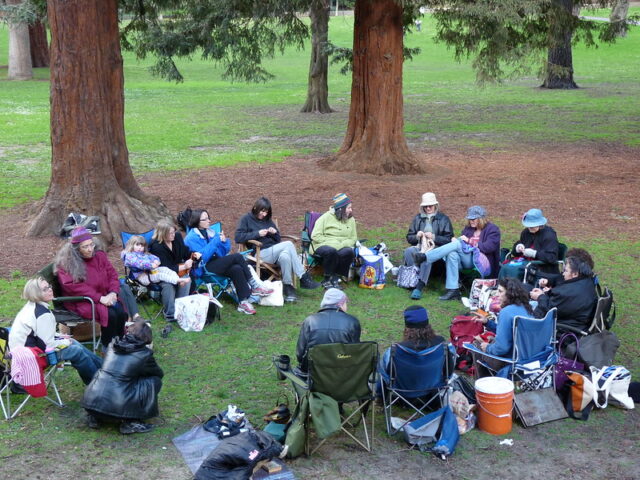
I’ve used this photo before; I’ll surely use it again. Our weekly circle, back in the day.
Dear fellow wonderer,
Recently a Substack note from Edan Lepucki caught my eye. I always love Edan’s takes on parenthood. She was reflecting on a list of tips for having a baby. While she admired much of the list, this tip bummed her out:
Advice from people who had their last baby more than 5 years ago is going to be out of date. Advice from people who had their last baby 20+ years ago is going to be mostly obsolete.
That tip made me tear up, to be honest. Indignance, maybe. I had my first baby in 1992 and my last in 2001. I’m beyond obsolete.
Edan writes:
Older friends and my own mother were/are so helpful to me as I raise my children. Why ignore wisdom from more seasoned parents we trust? It’s time, instead, to seek these people out! Just because someone was a parent of a baby a long time ago doesn’t necessarily mean the experience no longer applies. Wisdom is wisdom!
Edan is a novelist of note–I’ve finally gotten to reading Time’s Mouth and it’s fantastic–yet it’s her writing on parenthood that always grabs me. Her thoughts on why she doesn’t play with her kids (NYT gift link), why she doesn’t track her kids, and especially this on admiring their unhinged play–making space for it and letting it be theirs, and not turning it into a skill for a someday college application.
“We’re just trying to help our kids find what lights them up.” Amen to that, sister.
Edan’s takes on parenthood are somewhat anachronistic, atypical of today’s parenting norms. I wonder how much this has to do with wisdom gleaned from people whose advice is “mostly obsolete.”
* * *
Maybe you’ve heard about the trend to keep outsiders at bay after having a baby–grandparents, family, friends–and to make a private nest with your new nucleus of a family. I first heard about this shift from a fellow older mother whose expectant daughter planned to follow the advice, who was not sure how many days it would be before she’d meet her grandchild.
I was surprised. Though I absolutely agree that new parents shouldn’t be forced into the role of entertaining in those first days, and anyone with a fraught parental relationship might want to delay interaction, but this woman and her daughter were close. The daughter had received the advice from friends, it seemed? And Instagram, maybe? From women her own age, apparently. Wanting to be respectful, her mother didn’t pry for why.
This advice, to me, goes against so much long-held wisdom: the time after a birth was typically a time for a mother and baby to be cared for by others, especially a circle of women. I know that’s not how things generally play out in modern society, yet might it be helpful to focus less on keeping folks out and more on how others might support the new family unobtrusively with meals and care? Until I gave birth to my first baby, I could not have imagined how much I needed to see my own mom immediately, exhausted and exhilarated and needing to say, through tears, Mom, I did it! to the one person who would understand, completely, the portal through which I’d passed. I think of my mother-in-law showing up to see the baby with a batch of lemon bars, my favorites. She didn’t bring those lemon bars for my baby, my husband–those lemon bars were for me.
I ran this scenario past my daughter who, to be fair, has no babies planned on any near horizon. She said, “Are you kidding? You’re going to be at my water birth and then you’re making me what I want for dinner.” Haha, yep, assignment understood.
Ultimately, the daughter of the woman I spoke with seemed to change her mind at some point, before or after giving birth. I learned this from ebullient grandparent hospital photos, pinged to me on my phone.
* * *
Admittedly, I know what it’s like to think your own generation parents better than generations past. I became a mother after studying developmental psychology, after being a preschool teacher, an elementary-school teacher and I sure believed I knew more about how kids learn than my mother did. And that was likely true, from an academic standpoint. But my own interest in kids went way back to my childhood, when my mom “babysat” for kids in our house, years before childcare was a licensed endeavor. Some days there were a dozen kids roaming our house, watching Sesame Street, getting hollered at for sliding down the stairs. I got a lot of experience, back then, helping with babies, toddlers. And though my mom wasn’t doing much by the book, she clearly knew a thing or two about kids.
The Cultural Contradictions of Motherhood is a compelling read from 1996. Sociologist Sharon Hays notes a shift in motherhood, which she called intensive mothering, a term still bandied about today, widely and often judgmentally. Hays writes, “The methods of appropriate child rearing are construed as child-centered, expert-guided, emotionally absorbing, labor-intensive and financially expensive.”
Reading that line, recently, gave me pause. I was a young mother during the years Hays writes about. I’m still working through which of those methods I believed in, clung to. (It’s everywhere in my manuscript draft–stay tuned!) But I definitely had different beliefs than my mother had.
Hays was on to something. Belief in those methods has only amped up, exponentially, in the past thirty years.
* * *
You know I’ve been writing about the expert-guided bit. I’ve written about the rise of parenting books in the ’90s, when I became a mom (my angst with the Searses is here) and I’ve tracked those shifts into current times, and my frustration with current “experts” who complicate parenthood in their drive to make a buck. (That post has been shared and commented on more than anything I’ve written here. Folks seem to share my frustration.)
I’m wondering about this: Many young parents–mothers for the most part– seem to be mostly gleaning advice from “experts” (whose “expertise” is more commodified than ever. See: monthly memberships) and from friends and influencers in their same age cohort.
How does that impact cultural beliefs about parenthood, childhood? What happens when the learned experiences of older parents are not there in the minds of newer parents–minds already maxed out with constant inputs and information about how to parent better?
* * *
I struggle with writing about homeschooling here. It’s a concept more misunderstood and maligned than ever, courtesy of books like Educated and this new one, Homeschooled; courtesy of all those Instagram mamas home with their flocks, skipping vaccines and mixing millet muffins in milkmaid dresses. So here’s a disclaimer I might just cut and paste from here on out: Yes, I homeschooled with my kids. I was a former public-school teacher who saw homeschooling as a way to save on childcare costs, as a grand experiment in progressive education. My kids turned everything I thought I believed about learning on its head, taught me to value interest-led learning and independence. Yes, we had a vibrant community of friends. Yes, all three chose to attend high school. Yes, I believe that homeschooling expanded my kids’ worlds, rather than limiting them. No, I don’t believe that everyone should homeschool. I want public schools to thrive and wish we could bring more homeschool-style interest-led, individualized learning to the public school classroom.
Anyway! It’s pretty damn scary to choose an uncommon path as a parent. To, say, decide to homeschool with your kids in 1997. I will tell you this: we newbie homeschooling parents were desperate for the stories of older homeschooling parents, especially the parents of teenagers. We needed to know that what we were doing would be okay, that our kids could turn out happy and smart and not totally weird.
What that looked like: we met weekly at a park, circled up chairs. (A zillion other gatherings happened between these park days too. Learning groups, field trips, twice a year camping trips…) Parents of toddlers followed kids around the park but eventually we’d graduate to sitting in the circle while our kids ran off and played or, once they were older, wandered off for candy and freedom at the corner store. Meanwhile, for hours we parents had the (acknowledged) privilege of chatting, swapping stories, and even gleaning some advice, especially from more experienced parents.
Eventually my kids got older and I became one of those experienced parents. I’d seek out younger parents who showed up with a kid on their hip and eyes full of doubt, offering lots of You’ve got this. You’re already doing it, have been doing it since your kid was a baby. Keep going!
I can not imagine what it would have been to take that leap with only guidance from “experts” and folks as green I was.
(And later, when I saw people online, selling themselves as homeschooling experts though they hadn’t yet raised teenagers? I’d snort a little, roll my eyes.)
* * *
Edan wrote in her note about that newsletter list: “I feel like in the absence of these (more experienced) guides people end up going online for advice from randos. PS If you need my mother’s number let me know.”
Online advice from randos. That’s a big part of these shifts in parenthood, I think. Most young parents likely don’t have the luxury of lots of in-person time with other parents, especially parents of different ages and experiences. So online advice fills that gap.
It’s worth noting that most of this advice comes from people seeking some sort of personal gain. Your credit card, for example, from “experts” with books and workshops and monthly memberships. Your follows from influencers who make a living based on the size of their audience.
That’s distilled advice aimed at an outcome. It’s coming from a person who likely doesn’t know you or your child or your situation. There’s no context or nuance or mutual give and take.
I don’t believe that as humans we’re meant to learn from straight-up advice. If I learned one thing from homeschooling, it’s that top-down teaching holds far less fire than a person chasing their own questions and curiosity.
* * *
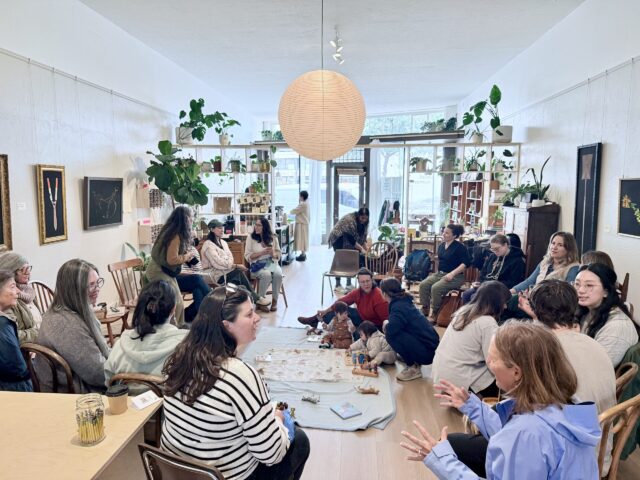
I’m thinking about the reading series for caregivers I’ve been hosting at the fantastic new community space here in Oakland, Local Economy. Folks bring babies for conversations with writers who’ve written books on caregiving. And oh, the babies, those gushy, gummy babies! Sometimes I even get to hold them! But what’s been especially cool is the audiences aren’t just made up of parents of babies; there’s been a mix in ages of attendees, so the discussions have been deep and rich. Some advice from elders thrown in on occasion, but mostly a lot of back-and forth conversation.
I’m thinking about two sets of neighbors with young kids, who I didn’t know until a few months back, when they put postcards in mailboxes up and down the street, inviting folks to a Sunday driveway bagel hangout, which led to a WhatsApp group of six households with little kids, with teenagers, with grown kids, which led a couple weeks back to a progressive dinner that ended with dessert at our house and still gives me goosebumps just to think of it, that warm and neighborly coming-together. (I’m tempted to post a photo of them circled around our kitchen table, beaming up at me as I stood on a chair, but I didn’t ask for permission so you’ll just have to picture it.) Were we older parents giving advice? No. But we were talking about our grown kids and their experiences, and listening to the experiences of the younger parents. In between riesling and spring rolls, we were getting to know each other, learning from each other.
This is how, I think, we’re meant to learn how to be parents. In community, via shared experiences, via stories and questions and conversations. A little advice thrown in sometimes, some reading, sure, but mostly learning through what we glean in context, based on what we want to know.
I even wrote, just before transferring my 16-year blog to this substack, about hoping this newsletter might become such a space.
I know the limitations of giving advice, but sometimes I can’t help myself. So I’ll be like the broken record that my old, beyond obsolete, record-playing self can’t resist. If you’re craving advice, maybe consider expanding your sources of advice–and whether you need advice at all. Maybe try listening to that voice inside, the one who knows your kid best.
xo,
patricia
P.S. If you’re local, February’s Storytime for Caregivers will be with Minna Dubin, author of Mom Rage. It’s gonna get fiery! Date TBD, announced soon here.
Cross-posted at substack.