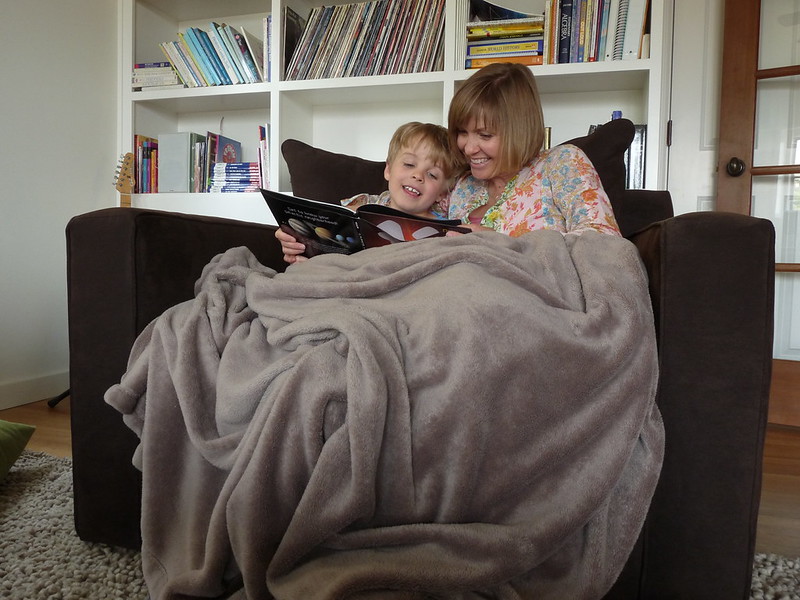
He liked to pile us with blankets when we read together. He called it “a jumble of cozy.”
Dear fellow wonderer,
Shifts in childhood, shifts in parenthood. That’s my thing here, as you know. Recently I came across a shift that made my chest pang:
“Fewer than half of parents of children up to 13 years old say reading aloud to children is ‘fun for me.’
Gen Z parents, who grew up with technology themselves, are significantly more likely than Millennials or Gen X to view reading as “more a subject to learn” rather than a fun or enriching activity.”
A subject to learn! Sob. This was from a UK study. In the U.S., Scholastic notes a similar pattern:
“The number of parents who started reading aloud to their
child before the age of three months has declined since 2018.”From 43% in 2018 to 37% in 2022.
That drop in a mere four years.
* * *
Call me sentimental. Some of my favorite motherhood memories involve reading to my kids. Reading my own childhood favorite, Bread and Jam for Frances, to each when they still had dimpled hands. Nodding off in their beds as I read aloud from Pippi Longstocking. Lapping the kitchen table reading Roll of Thunder, Hear My Cry while they made sushi and starfish from Fimo clay. The Great Brain in a tent by flashlight. Books I hoped they’d love. They did.
This was before mothers were slapped with the expectation that we should play with our kids. Sure, I’d play board games on occasion, and I’d always visit their shops and restaurants, my fist full of fake cash. And I’d talk to them endlessly, about Pokémon powers, or American Girl Doll outfits, or Wolverine’s Adamantium claws. But mostly I let them play by themselves. One of my most beloved ways to connect with my kids was to read them books.
But here you are reading this newsletter. You’re likely a fellow member of this club.
* * *
I’ve been thinking about this after reading a post from research psychologist Peter Gray in which he’s disturbed by various recent headlines: “Fewer Parents Are Reading Aloud to Kids” and “Why Kids Aren’t Falling in Love with Reading” and “The Nation’s Report Card Shows Declines in Reading Scores.”
Maybe you’re noting a progression there.
Gray believes that these shifts are at least partially due to school reforms prioritizing a “skill and drill” approach to reading, which he sees as beginning in 2010 with the adoption of the Common Core Initiative. I’d argue that it started earlier, after the No Child Left Behind Act was passed in 2001 and federal funding became based on standardized test scores. Change occurred at different times in different states, but reading was the area in which the most dramatic shifts occurred, with a lurch from real literature to textbooks and systematized study aimed at proficiency on tests.
I’ve been wanting for years to write a deep dive on my issues with the Sold a Story podcast–but others have done that thorough work for me. That podcast single-handedly convinced a generation of parents to believe in “the science of reading” (intended sarcasm in those quotes) and to entirely dismiss the approach that came before–the approach I used in my own early ’90s classroom–an approach that centered building a love of actual books for kids. Yes, I believe that phonics skills have a place in the learning-to-read toolbox–but as Nick Covington’s response above argues, phonics is being overprescribed as a single salvation to illiteracy in a move that ignores research, that rewards–mightily– curriculum publishers, that undermines teacher professionalism. And maybe most short-sighted of all: this approach is more likely to make kids dislike reading than come to love it. 1
I agree with Gray: “It is not surprising,” he writes, “that the biggest decline in joy of reading, found in the Scholastic survey, occurs between the end of second grade and the end of third grade. At most U.S. schools, third grade is the first year of high-stakes testing in reading, so that’s when the skill-and-drill mode of teaching begins to hit hard.”
I taught third grade. Back then I read aloud to my students every day; every day we had twenty minutes of silent reading, each student reading a book of their choice. I’d save Scholastic book club points, use my own money to purchase books I hoped they’d love. When I shared a new one for our classroom library, students would race across the room to get their hands on it first.
“Slow down,” I’d say, laughing. “You’ll all get a chance. I promise.”
* * *
The pressure to make sure your kid can read weighs on most parents, but if you’re a homeschooling parent, like I eventually became, that pressure can feel massive, monumental. I was incredibly lucky to have an oldest kid who learned in a visual way and was driven to figure out what those letters on pages were doing, and who mostly taught himself to read by six. His two siblings, however, seemed to prefer taking in language through their ears. Both could listen to audiobooks, could listen to me read for hours, but the drive to read themselves was slower to show up.
This was painful for me! I wanted to push! But there’s some backstory here about how I’d made my oldest scream, “I hate writing!” and I sure didn’t want to repeat that mistake with my younger two when it came to reading. Instead of pushing them to read, I channeled my literary fervor into searching out books I thought they’d love–to read to them, to fetchingly display in our book basket, to strew across the kitchen table.
It worked out. Many, many years ago, I wrote about how my patience finally paid off with my youngest.
Of course, as a homeschooler, I had the freedom to wait. But public school shifts toward testing and standardization have pushed reading down to the kindergarten level--and often even to preschool.
Just look at the collection of news headlines compiled by Gray and I think you’ll see where this has taken us.
* * *
My teacher friend Adrian wrote recently about how each year, fewer and fewer of his fifth graders are readers.
I admit that some days I feel desperate for a solution. I realize that I am fighting a losing battle, but I keep looking for ways to convince my students of reading’s value. I cannot compete with TikTok and YouTube influencers for my students’ attention. Video games will always offer my students’ brains a more immediate dopamine fix.
That losing battle. I’m grateful that there are many, many teachers like Adrian who, despite being enmeshed in a system that makes it hard to cultivate a love of books, keep trying anyway. But we all know how kids’ attention is being held captive these days, how everyone’s attention is being held captive.
You’re all readers here, why preach to the choir? Because the more I study shifts in childhood, the more I understand that we don’t always see the impact of shifts until they’ve clamped down.
The best way to push back on this particular shift, I believe, is to make reading a joy when kids are little, before those other attention-grabbers dig in their tentacles.
* * *
The single aspect of parenthood that always tripped me up, that trips many parents up, can be summarized in a single word: preparation.
It’s noble of us to want to prepare our kids, give them the skills they might need in the future. But that often makes us lose sight of what’s happening today. When it comes to little kids and books, our drive often becomes answering the question: when will they read? instead of centering the joy of reading together.
It’s embarrassing how long it took me to understand this, but the best way to help a kid read is to help them love books today so eventually they’ll want to learn to read. 2
I can look back and see what worked: non-negotiable nightly read-alouds, guaranteed or there’d be mutiny! Weekly trips to the library where my daughter collected armfuls for herself and my boys settled in with comics and relied on their mother to find all the wacky atlases and Weird But True! compilations and Roman mysteries I knew they’d enjoy. (Grrr, but whatever it takes!)
And audiobooks! I checked them out, I bought them, made sure there were always options for their bedrooms, for the car. My older two spent hours listening while building with LEGOS and making stuff; the youngest tended to listen and pace. The Harry Potter series, Jim Dale’s stories, The Chronicles of Narnia. I have utterly no sense of how many books we took in together in the car. Our shared love for one series made us a fan club of four. I’ve written before about how my older two, at eight and five, gobsmacked me with their critical discussion of Long John Silver’s character in Treasure Island, and how, while listening to Huckleberry Finn, all three hit me with profound questions about the varying nobility of Tom and Huck and Jim. Even the youngest, at five, had opinions. What I couldn’t have predicted: these casual conversations about books ended up being an incredible education in literary criticism and appreciation that I only recognized once the kids were older.
When I facilitated writer’s workshops for kids, I could always recognize the audiobook-listeners because their writing had a cadence and sense of storytelling that came from taking in books through their ears.
I wish I could tell every parent who worries about too much screen time to get their kids hooked, early, on audiobooks. Both visual and audio media fulfill that entertain me need, but audiobooks require so much more work from the mind. The listener has to construct the world they’re hearing about–and that’s valuable mental work. (And omg, the words and phrases my daughter would drop into conversations at five or six, picked up from audiobooks: sodden and perplexed and you have a severe lack of moral stamina!)
My own antidote to not pushing too much, I see now, was channeling my energy into searching out books I hoped they’d fall for.
* * *
I understand what we’re up against here, that our attention has been seized by so much flash and dazzle. So much latest newness. How can books stay relevant?
Ten years ago, almost to the week, I wrote a post about my youngest.
The first two lines:
I don’t like reading.
This is what my 14-year-old says, just before he breaks my heart.
It’s a nuanced post about a kid who grew up in a book-loving household who didn’t like to read books. About me struggling with the fact that, though he read plenty of words, books weren’t his chosen vehicle. That he said things like, Books aren’t the best way to tell a story and You’re just being nostalgic.
That he was so different from his ’90s-born siblings. His ten-years-older brother texted, “Haha, yeah, he’s a child of the future.”
* * *
I don’t want a book-less future childhood. I’m trying to tease out why I think books still matter.
I keep coming back to my drive to be a book curator for my kids. There’s something there. Because there’s nothing like finding a book that’s just the book you need right now. It doesn’t always happen, but when it does! That intimacy, between you and the narrator, doesn’t quite exist in any other art form. Music, maybe, but music seems more expansive–you can do other things as you listen. Not so with reading, at least book reading. (Audiobooks offer a different experience–still a fan!) With book reading you must focus on that writer’s words to the exclusion of almost anything else.
How often do we give anyone or anything that sort of attention these days? (You’re doing it now. I’m grateful.)
It worries me–quite a lot–that we’re losing something vital and human if we don’t give kids the chance to experience books that way. If today’s parents didn’t grow up loving books, there’s no love to pass on to their kids.
And yet, from that Scholastic report: 80% of kids say reading aloud is or was a special time with their parents. 92% of parents agree.
* * *
I happen to know that the 14-year-old who is now a 24-year-old does read books these days.
I texted him to ask about recent reads and got this:
“Haunted by Chuck Palahniuk
The Fall by Albert Camus
A Visit from the Goon Squad by Jennifer Egan
Meet Me in the Bathroom by Lizzy Goodman
The Secret History by Donna Tartt
On the Road by Jack Kerouac”
“I love A Visit from the Goon Squad!” I texted back. “Did I recommend it or did you find it on your own?”
“I think you recommended it.”
Apparently my work here is still not done.
As always,
Patricia