Dear fellow wonderer,
Lately I’ve been wondering what today’s parents think of play. We all know play is good for kids, but I suspect it may sometimes seem like one more responsibility, one more thing to fit into busy lives, one more thing to maximize. Something to do with kids, maybe, to make sure they get it right.
But underneath that, I wonder if today’s parents feel something else, maybe something they don’t admit, that might be subconscious, something I unearthed in my own mind back in the day: that play is, at its core, frivolous.
Given my background, it’s surprising that this belief still took residence in my brain matter. I’d studied psychology as an undergrad, with a focus on developmental psych. I’d worked in a preschool while getting my teaching credential, and then taught seven and eight-year-olds. I knew better.
And play was all fun and good in my first years as a young mom–but then we made the decision to homeschool. (See disclaimer!1 ) This new path revealed a whole new set of responsibilities and fears and questions, and underneath it all, that hidden belief: play is frivolous.
* * *
Something set me straight and that something showed up again recently, surprisingly, in the work of two different people who have devoted their lives to play.
I’m always nattering on about Peter Gray, a research psychologist who specializes in play. I’ve also been, more recently, following the work of Lizzie Assa, a former preschool teacher who helps parents understand the value of play, and how to incorporate it into their children’s lives.
Listening to both in recent interviews and reading Assa’s new book, But I’m Bored, I was surprised to note how much importance both gave to the simple practice of observation. Watching kids.
“Once you pay attention to kids at play,” Gray says in a recent interview, “you realize the amazing things they’re doing. The level of the conversation, the level of the activity, it becomes more or less obvious how they’re learning while they’re playing.”
And Assa, in her book: “We all watch our kids, but intentional observation can reveal things about your child you might not have consciously noticed before.” And: “You’re learning about what captivates them while they drive their own play.”
Observation. Of course. The very act that shifted my own beliefs about play.
* * *
In this, I was lucky. My training had given me years of practice observing children. In my psych studies, I played with babies behind a one-way window in the Infant Development lab, hiding stuffed penguins behind my back to test their notions of object permanence. And later, as a teacher back in those child-centered learning days, we gave students open-ended opportunities and measured their learning not through testing, but through watching.
As a homeschooling parent, I felt such a responsibility to prepare my kids. To structure their time in an efficient way so we could fit in everything I thought they should learn. I’d done this as a teacher, after all, filling in my lesson planner, day after day.
Things were not so straightforward at home.
Most mornings I’d read aloud to the kids. Always, they wanted me to read longer than I meant to and, book-bimbo that I am, I’d keep going. Then I’d glance at the clock, see it was almost lunch, and alarms would set off: the math we weren’t getting to! The writing! Science!
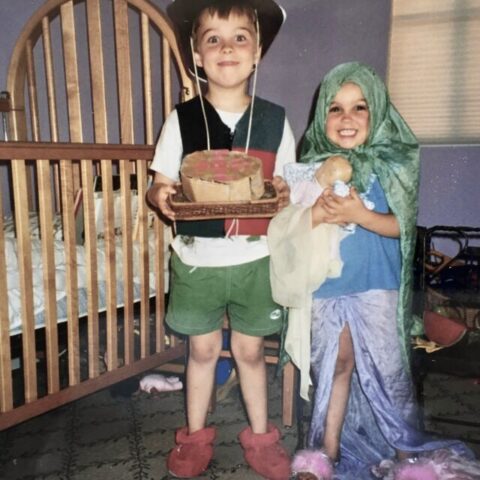
I’d be rustling up some math project, a hundreds-chart, maybe, for H. who was seven, and I’d hear a chair scraping across the floor. L. was four, and she’d flash past, soon back with some prop. A silk scarf tied around her neck one day, an armful of plastic bread slices.
“Put these in your pockets,” she told her brother.
Shit. I’d been reading Meet Kirsten, the American Girl doll story of Swedish immigrants. Not high literature, but they liked it anyway.
He’d already placed blankets across two barstools, was pointing beneath.
“Girls on the bottom bunk.” Just like in the book.
After I’d read, they always wanted to play. As tiny people after The Borrowers, as hermit crabs after Pagoo. I never factored in time for this.
I’d want to interrupt, get H. cracking on that chart, but what they were doing compelled me. Up from their bunks, they were running down the gangway and into New York City. In loops they dashed around the stairwell, through the family room, the dining room, the kitchen, L.’s silk shawl fluttering in their wake.
* * *
“Play is how you develop skills,” Gray says in that interview, essential viewing if you want to understand play’s importance. “Play is practicing things.”
Why do baby animals play? Why does their play look like fighting and escaping and hunting and capturing? They’re practicing the skills they’ll need as adults.
Play is also the one place, in lives increasingly guided by adults, where kids get to be in control.
My friends who teach college bemoan the fact that their students today, more than in the past, don’t take initiative, don’t seem to know how to take initiative. They hold their opinions close and wait for professors to tell them what to do.
Many want to blame phones for young people’s disengagement, but as I’ve written, I’m not convinced phones are the central problem.
“I had a conversation with a therapist who works with college-age kids,” Assa shares in a recent interview, “and she said to me, all of these kids come from these really high achieving areas, and they were brought up on club sports and enrichment and activities and tutors, but now they’re in college and they’re really struggling with basic things like decision making, feeling like every little thing could possibly be the end of the world and afraid to take risks, and they’re not sure what to do if someone doesn’t tell them how to start, and to me, I felt immediately like, wow, I don’t think that’s really a college problem, that’s a play problem.
Play really is the thing that builds deeply…in the fabric of who they are, their executive functioning skills, their confidence, their ability to start when no one has told them what to do yet.”
* * *
Back in their bunks, their voices drifted across the kitchen tiles.
“Waves crashed over the side of the ship,” said he.
“The wind howled like a pack of wolves,” said she, reeling off the line precisely from the book. A cliché, but still.
How could I interrupt that? I turned my back on the blank chart, opened the freezer, pulled out bread for lunch.
* * *
The more I watched my kids, the more I understood their play was far more impactful than any lesson I could plan. Acting out stories, they were playing with language, engaging with one another, negotiating, trying out roles, imagining possibilities.
I watched them play as Squirrel Nutkin and his brother, Twinkleberry. I watched them play as planets, after we’d read about the solar system, H. as Mercury, moving fast and L. as Neptune, dancing slow. I watched them play as Ohlone people, applying what we’d learned on a regional park trip, him spearing stuffed rabbits, her stirring acorn mush over a silk scarf fire.
After I read The House at Pooh Corner, neither wanted to be Pooh—too cotton-headed, I suppose. She’d put a hand on her hip and urge him to be Christopher Robin (in his Land’s End rain boots) but of course he’d rather be Tigger, boinging around the family room, hollering nonsense in the third-person: “TIGGERS DON’T LIKE HONEY!”
Sometimes she was Piglet, or sometimes Roo, or sometimes Kanga with her Cookie-doll peeking from the waist of her striped leggings, endlessly muttering, “Tut tut, it looks like rain.”
They were expert curriculum writers, my kids, designing ideal follow-up activities that cemented learning, expanded it, created further learning opportunities–and the activities they designed were absolutely and utterly and perfectly engaging to them.
* * *
There’s so much more, about what kids glean from play in larger groups, especially when adults don’t interfere (which Gray discusses at length in his interview.) So much more that I’ll save it for a separate newsletter. Let’s keep our focus on play at home, on kids playing alone or with one or two others.
I appreciate Assa’s newsletter and her book, pitched as a guide to discover the power of independent play to raise confident, resilient kids. You know I’m hesitant about “experts” schilling a lot of complex advice on how to be a parent, but that isn’t what Assa is doing here. She conveys what independent play does for kids in an accessible way–develops self-reliance! improves perseverance!–and she’s particularly forgiving and non-judgmental of parent-readers who are still learning. She offers simple ways to help families make it happen, ways that are pointedly not Pinteresty.
Many parents I’ve spoken with tell me their kids don’t like to play alone, don’t know how to play alone. Assa helps parents understand how to leave out simple items in inviting, open-ended ways: a line of blocks with a car on top, a basket of cars and blocks beside; a lump of play dough and a kid’s favorite figures–yup! (When she writes about devoting a kitchen cabinet to art supplies rather than pots, I knew I’d found a kindred spirit–it was a heartbreaking day when I cleared out ours.) Assa suggests making “play pockets” around the house, some where kids can be near you–where they want to be–while also playing on their own. There’s so much brilliance in her book, ideas I’d never considered, that I will have to work hard to tamp down my grandparenthood longings. (And I know what I’ll be giving as a gift to new parents.)
Assa reminds us that watching your child play teaches you who they are. “It’s a really important way,” she says in that interview, “to understand your child’s development, to understand their interests.”
Yes. I think we mothers often humble ourselves, don’t call out what we do well. I’ll say this about myself as a mother: As time went on, I got really good at watching my kids, at valuing their interests, at helping them make those interests a guiding force in their lives. And watching them play is where that began.
* * *
I’ve written before about how many parents today think they should play with their kids, constantly interact with their kids–and how I once worried about that too. I especially love how much space Assa gives to debunking this notion. “Time alone can replenish everyone,” she writes in her book, “so that family togetherness becomes the reward and the payoff, rather than another stressor.”
Independent time, then shorter bursts of real connection. Assa describes how to make this so.
Often when I tell people that I homeschooled with my kids, they say something along the lines of I could never spend that much time with my kids. What they don’t grasp, I think, was how much time my kids spent entertaining themselves. Even my youngest, whose siblings were older by six and ten years, making him more like an only child, was an uncertified Play Expert.
My kids could play. And as they got older, that morphed into lots of time spent on their own, chasing their interests.
* * *
Why did I believe down deep, early on, that play was frivolous? I think it comes back to that desire to prepare my kids–to give them the knowledge and skills they’d need to become happy, successful adults. That’s a ridiculously tall order and it revved up fear. Fear that I was missing something, not doing it right, not giving my kids what they might need.
When we feel fear, we want to ameliorate that fear with a sense of control. And I think one way we parents believe we’ll gain control is by managing our kids’ time. Devoting their time to what’s productive, what promises future payoff.
Guess what? Kids are biologically driven to accomplish those goals, in part, on their own! That’s the purpose of play.
Yet play is disappearing from kids’ lives, as Peter Gray routinely explores in his newsletter. This recent interview with a writer of a new book on kindergarten divulges how play areas in kindergartens now are mostly unused, if not entirely removed.
Kids need play. Like food, like air. I hope we can help create more space for it in their lives.
As always,
Patricia
cross-posted at Substack
- Yes, I homeschooled with my kids. I was a former public-school teacher who saw homeschooling as a way to save on childcare costs, as a grand experiment in progressive education. My kids turned everything I thought I believed about learning on its head, taught me to value interest-led learning and independence. Yes, we had a vibrant community of friends. Yes, all three chose to attend high school. Yes, I believe that homeschooling expanded my kids’ worlds, rather than limiting them. No, I don’t believe that everyone should homeschool. I want public schools to thrive and wish we could bring more homeschool-style interest-led, individualized learning to the public school classroom.