
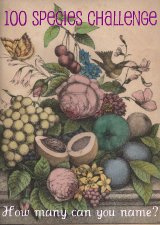
Okay, so I came across this challenge on Melissa Wiley’s blog. It originated here, when scsours contemplated a quote that most people can’t recognize 100 plant species within a mile of their home. The challenge is to go out and learn the names, and a bit more, of 100 plants in your neighborhood.
Ooh, I loved this idea immediately. I’m pretty good with plant names, especially garden plants, and herbs and other edibles. Many of the Latin names even manage to velcro their way into my brain. I’m sure there are plenty I don’t know, though, especially trees. And wouldn’t it be fun to do with the kids?
Apparently not. When I mentioned it to one of my children, who shall remain nameless, she (ahem) rejected the notion as quickly as I had fallen in love with it. “I don’t want to do that,” she said. “I just want to do life science.”
Oh, life science. Silly me, suggesting plants.
When will I learn that my kids’ desire to do anything is inversely proportional to my suggestions that they do it? In plain English: If Mama thinks it’s a good idea, it must be a bad idea. Sometimes I think they say no simply because I’m suggesting it, without considering the suggestion at all. I guess they’ve spent years having to fight off my Boundless Excitement over Learning Opportunities. Mr. T. is still young enough, at six, that he’s often willing to get caught up in my enthusiasm, but he has such a creative way of looking at the world that he usually veers off my path pretty quickly.
I probably should have quietly started this myself. I could have asked the unnamed child to figure out how to put her camera in macro mode and take a picture for me. I could have looked up a Latin name and researched its meaning in this this cool book. Then I could have casually mentioned it to a nearby child. Latin names are very Harry Potterish, you know, and I think Mr. T would dig that.
There’s a part of me that hates the notion of having to be sneaky about what I want to share with my kids. But I guess that’s better than being told flat-out that they’d rather do life science.
I see that Sandra Dodd, unschooler extraordinaire, is taking on this challenge. Check out her subtitle: “In Which Sandra Dodd Follows the Lead of Others in Trying to Identify by Name 100 Local Plants”. Notice that no kids are mentioned. This is her quest. I’m sure I could learn something from that.
But I keep thinking how fun it could be to make plant trading cards, you know, Pokemon-style, with Latin names and cool facts…no, no, stop me! Remind me to keep it to myself for now! Remind me to play with the idea of this challenge, think about how I might do it myself–and maybe strew a few enticing crumbs along the way.
If you want to take on this challenge yourself–alone or with kids who are more cooperative than mine–you can read the Official Rules and sign up here.
Yeah, as much as I absolutely adore hanging out with people who share my ubergeek — whoopie!! isn’t that fascinating!! approach to life, I guess my kids find it, well, embarassing. I think my sister did for years. But hey, it’s how I’m wired. I try to not overenthuse at them, but it’s impossible to cut it out completely.
I just say, “Hey, look at this,” and then drop it. They rarely follow through on things for long anyhow, so I had very much better want to do something if I want them to do it, too.
Hard balance.
hi! thanks for the nice comments on my blog. your ‘waldorf guilt’ post cracked me up. too true!
luckily, my kids are still young enough to think the ideas i come up with are fun. i’m sure that’ll change very very soon. this challenge sounds fun, thanks for the tip!