One of Mr. T’s favorite things to do is to tell me a story, and have me write it down. Actually, he’s been adding on to the same story for months now–Scritch and Scratch, about a boy and a girl turned into wolves who have many adventures in space.
Yesterday he was jumping out of his skin when he realized that he had a new story to begin, about a boy named Todding Toddington and his adventures in an alternate world, which other people can’t see. It’s part of what he’s calling The Series of Wonders. (And you know his Wonder Farm mama is lapping that up.)
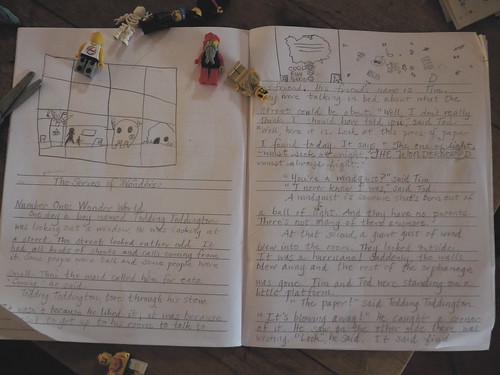
Mr. T would be happy if I’d take his story dictation every day–even several times a day. But I don’t. It’s time-consuming. And it’s tedious. But I try to get to it a couple of times a week because it brings him such joy. And, I realize, he learns an awful lot about writing in the process.
As prone as I am to making teachable moments of every gosh-darned thing, I try not to lapse into teaching mode when I take down his stories. I don’t say in my Dana-Carvey-as-The-Church-Lady voice, See how I start each sentence with a capital? or Did you notice how I spelled this word? Nope, I just write down what he tells me, and ask for clarification when I’m honestly curious about something.
Still, he’s learning so very much every time we do this. Yesterday I tried to take note of what he was picking up:
- He knows that sentences end with punctuation, because whenever he continues a sentence that I thought he’d finished, he sees me erase the punctuation and add it later.
- He knows that exciting sentences end with exclamation marks.
- He knows how to use quotation marks because he sees me do this whenever one of his characters talks. He’s also learned how to add he said or she exclaimed in the most dramatic places in the dialogue. I assume he’s picked this up from being read to, and from listening to audio books.
- He knows that titles are centered on the page and capitalized. He’s even noticed that minor words like of and the don’t get capitalized.
- He knows about starting new paragraphs when the story shifts gears. Often he’ll tell me to “start down here now” when he’s ready to move on in the piece. Paragraphing is something that’s often hard for much older kids to grasp; Mr. T has intuited it by watching where I add paragraphs in his stories. Often I’ll simply ask him, “Do you think we should start a new paragraph now? Is the scene changing?”
- In his story yesterday, Todding Toddington found a piece of paper with a poem on it. As I wrote down his poem, Mr. T said, “Shouldn’t it be slantways ’cause it’s a poem?” I realized he meant that part should be written in italics; I’m not even sure where he picked that up. So I erased it and wrote it in cursive.
- In his story one character said to another, “Are you a windquist?” I asked Mr. T what a windquist was, and I pointed out that his reader might wonder. So he said, “This is the narrator talking now,” and he defined a windquist. I said, “I’ll make a new paragraph, since we’re switching to the narrator.”
- He narrated the sentence, “At that second a giant thing of wind blew into the room.” I’m all for writing down lines as he says them, but if he uses vague words like thing, I’ll often check to see if he can come up with a better one. He struggled with finding the right word, so I became his thesaurus and suggested a few: blast, gust. Yes! Gust was just what he wanted.
My hand and my attention usually peter out after two pages or so. It would be easier to type his dictation into the computer, but I don’t think it would allow him to notice what I’m writing quite as well. Watching me erase and rewrite as we go seems to be a tangible learning experience for him. And allowing him to watch me write seems like a natural bridge to his writing himself eventually.
I love the thought that my kids have never needed grammar instruction; they’ve picked up the tools of writing by loving to write. Even if it meant that, for a long time, I was the one doing the physical writing.
As I was writing this post early this morning, Mr. T woke up. His first words to me: “What are we doing today? Will you write my story?”
Boy do I hate taking dictation. But you are making me think I should do it more. But handwriting it…now that is a labor of love.
I agree! <3 this post -thank you for the reminder/conviction!
And thank you for reading and commenting, Danielle!
Thanks for this inspiring reminder. My 7 y.o. is FULL of stories and things to say, but reluctant to write them herself. I need to carve out time to do these kinds of projects with her.
You’re documentation or proof of what Mr. T. has learned is so interesting. It reminded me of how John Holt would document how kids learn by just waiting patiently and observing them.
Thanks for the comments, friends. I don’t always love taking dictation either, but I did notice that paying attention to what he’s learning from it made it more interesting to me. And sitting beside him and getting a peek into his wacky brain is actually quite fun. I take advantage of his nearness and sneak in lots of kisses in the process.
I decided to actually take dictation instead of just thinking about it and I can’t figure out why I said I hated it. The story was hilarious and the kisses and hugs were great.
I managed to have a serendipity storm when I read your blog plus the comments by the Brave Writer author about how boys’ imaginations are often shut down because the (mostly female) teachers around them don’t want to hear what interests those noisy, violent boys.
So I paid attention, and when I offered to write down what he was telling me about “The Robber Duck,” here’s what I got:
The Rubber Duck
He steals rubber. And he’s fat. He sneaks in like real robbers into costume shops. He steals the rubber costumes. He carries them in a sack. And he wears a mask.
“But he’s very scary!”
“He’s a duck! Ducks aren’t scary!”
“But he’s a ROBBER duck, and all robbers are scary.”
“Oh, forget about it.”
He has a horn on his head, which he rams open doors with. He puts the rubber in a sack and at lunchtime he eats it and poops it into a pit.
The End
And then he was so excited about it that he copied it over in his writing into a little book he’s making. This from a child who has resisted all “let me write what you have to say, honey” blandishments from me.
Just the right action at the right time.
Patricia, just found your site! There is lots of information. I need help. My granddaughter attends a school that does not subscribe to Writer’s Workshop. Instead, she has to read a book, then, write a summary. Where do I begin? How can I help her? She is stuck on – start!!
Thanks,
Millie
Hi Millie! Is the problem that your granddaughter doesn’t know how to summarize the book she’s read?
If that’s the case, I’d work on talking with her before trying to write something down. Summarizing can be a challenging skill, especially if you aren’t used to doing it! You might try by practicing summarizing with her. Try books that you’ve both read, or even better–movies that you’ve both seen. Take a kids’ movie and see if the two of you can come up with a short summary of it. What are the main things that happen? As you do this, you can talk about what makes a plot element a main point, or something less important. It might be fun to see if you can summarize favorite movies in, say, three sentences. That forces you to distill the main ideas. Maybe try this with your granddaughter and make it like a game. It will help her refine her summarizing skills.
Once she’s comfortable with that, you might try some of the techniques I use in this post: http://patriciazaballos.com/2012/04/19/my-handy-dandy-process-for-helping-kids-write-nonfiction-based-on-other-sources/ It’s a post about writing nonfiction reports, which is a more complicated project than a story summary. But you could use the technique of having your granddaughter tell you the things she remembers most about the book she read, writing each idea on a separate Post-It. Anything goes–she doesn’t have to relay ideas chronologically or in order of importance. Then you go over the Post-Its together and sort them into the main ideas of the book. You take out the Post-Its that seem less relevant and you build what is essentially an outline for what she’ll write. The post goes into more detail on how to do this.
You don’t say how old your granddaughter is. I’m not sure if you’re allowed to write for her. If she’s struggling with coming up with the ideas for her summary, I’d encourage you to write for her, at least at first. Let her focus on the ideas rather than the writing. Later, she could always copy your writing so it’s written in her own hand, if necessary. I’m not sure if you saw my series of posts on taking dictation from kids. It might be helpful for you if your granddaughter is struggling with getting started on writing projects. I’ve taken dictation from my kids when they were working on their college application essays! Anything to help them focus on their ideas so they can get started. http://patriciazaballos.com/the-dictation-project/
Hope some of that is helpful. Please let me know if you need more help!
Susan and Stefani–I’m tickled that Mr. T’s requests to have me write his stories led to other kids getting their stories written down. And I’m glad you had fun doing it! It was especially wonderful to see Thing 3’s tale–I read it to Mr. T, and we cracked up together. Only a seven-year-old would have a rubber duck morph into a robber duck.
Here’s Greta’s first story. I typed it, because I don’t do handwriting (carpal tunnel). She loved running to the printer to get it. ` We read it many times. She dictated two more stories and then painted pictures to go with them.
Bird on Hunt
The bird was looking for worms and she couldn’t find worms so she started flying to the tree where she wanted to make her home.
She tried and tried. But she couldn’t find the right branch. And that was the branch she landed on.
But then she saw another same bird and it was a boy. And she was like, “I’m going to mate with him!” And then he was like, “Look at that lady over there, she is so beautiful. I’m going to marry her! Well, it will be so fun to get babies.”
Then the mother was trying to get sticks. And she went far away and got sticks and sticks and sticks to make her nest.
And then he flew over to her and he said, “What are you making?”
“Our nest, of course! Our babies are going to be laid. We need to make a few more nests and a few more sticks.”
She was called a red winged purple bird and I bet when the babies are hatched we could see one.
The End
Susan–I love it! Especially “Look at that lady over there, she is so beautiful. I’m going to marry her! Well, it will be so fun to get babies.”
Sounds like she has the male species figured out.
My 9 year old loves to tell stories and always has, they are fascinating, but I’ve never written them down. Occasionally for a project I’ve written down his answers to questions for a father’s day gift or whatever but I can’t keep up with him. He gets so far ahead of me that I lose track of what he’s said and he can’t always remember what he’s said but I know how it is to “lose your train of thought” so I don’t want to interrupt him. Any suggestions on how to keep up? I have 5 small children, he’s the oldest so the one problem I could see with him dictating into a tape recorder is that I don’t know if I could ever keep up with him and I’m sure the others have stories to tell as well.
Hi Dawn,
My eight-year-old has learned that if he wants me to write down his stories, he has to slow down for me. He’s had to learn to keep his idea in his head while he waits for me to get it down. That can be frustrating for him, I’m sure, but it’s a good skill to learn for when he takes on more and more of his own writing. It seems to help him if he’s able to move around while he dictates, to get out some of his energy, which would probably be harder to contain if he were sitting beside me and waiting. Another benefit is that while he’s waiting for me, he often rehearses what he’ll say next. Another good skill, as it makes his writing better.
I usually say the last few words of the sentence aloud as I’m writing them, so he knows when I’m ready for him to continue.
Having five small children presents a unique challenge, because most kids love to have their stories transcribed, and it would be nearly impossible to get to them all! But you don’t have to take dictation from each kid everyday (you’d never be able to do that with five) or even every week for it be beneficial. My son loves me to write down his stories so much, that we try to do it a few times a week, but often we don’t get to it. Still, there’s a cumulative effect, I think. Just the fact that we return to it regularly means my son is getting more and more out of our dictation sessions. I hope to write more about the specifics of that in the upcoming months.
Since you have several young kids, you might want to look into voice recognition software for your oldest child. This is something that I don’t have experience with yet, but I plan to explore it. “Dragon Naturally Speaking” is a software program that’s been recommended to me. It allows kids to speak into a microphone, while the computer makes the words into text on Microsoft Word. I still think it’s best if you can manage taking dictation sometimes, as kids can learn so much, for all the reasons listed above, and more. Especially, having you ask questions when something in their dictation confuses you teaches them an awful lot about revision and writing for an audience. But if your son is a natural storyteller, that means he’ll have a natural voice as a writer, which is such a good thing! You want to help him translate that to the page (or the screen), so voice recognition software might be a help, if you can’t transcribe for him as often as you’d like.
You could also have the children “dictate”, or tell their stories, into a camcorder. I have great videos of my daughter telling her “Happy Time With Abbey” videos. She was hilarious, and I captured a priceless time in her life. But I “get” what you say children will be able to get out of the printed process of the story . . . maybe you could transcribe from the video better than from the audio only?
Dictating into a camcorder is a fun idea, Cindy, especially for kids who like to perform. It might be a good transition to dictating for the page for kids who are leery about offering dictation. And seeing their video transcribed into a printed script might interest some kids.
Thanks for stopping by to say hello, and for mentioning me on your blog!
Patricia, my name is Darcie Davis and I can’t tell you how happy I am to have discovered your blog! Is it possible to email you directly? I have some questions about teaching my kids to write and love your approach, but still feel I could use a little encouragement! I look forward to hearing from you.
Darcie
Awesome ideas thanks!!
Never wrote a comment on a blog but I must say thanks as a mom of a blossoming writer I struggled how to make her better and expand her ideas. You gave me great ideas. I never thought about dictation as a learning tool for an 8 year old but think it will help her finish some of her stories and add more details.
Celeste, I received your first blog comment ever? I’m honored!
Dictation can be such a great tool for an 8-year-old. So glad you’re considering it! I hope you’ll also consider coming back and commenting again, and letting us know how it goes.