Mr. T and I have been playing with probability lately. The other day he made a spinner.
We got the idea from Math By All Means: Probability, Grades 1-2. I really like these books by Math Solutions, particularly the Math By All Means series and the Teaching Arithmetic series. I used them back when I was teaching (and was even one of the test teachers for the first Math By All Means book, on multiplication.) Each book is a series of activities on a single math topic, geared for a certain age group. The emphasis is on presenting interesting activities, and letting kids figure out their own ways of making sense of the problems. The books aren’t for everyone: each activity has many pages of explanation, with word-for-word dialogues of how a teacher introduced the idea to her classroom, what the kids said, and examples of their work. For some that’s overkill, but if you’d like to get a better sense of how to let your kids use their own smarts and learning style in math, the books are fantastic. The math philosophy behind all Math Solutions books is sound: it’s always about comprehension, rather than rote learning.
It’s also nice to have the work of other kids to share with your own child–hard to do in a homeschool setting. And when activities require looking at larger pools of results than you’d have with one or two kids, you can always look at the classroom results reproduced in the book.
And no, I am not a rep for this company–I just think these might be books that homeschoolers might not come across on their own. We’ve never used math texts until my kids were close to their teen years; we use a variety of activities, games and books. These Math Solutions books are a backbone we return to often. But even with them, we don’t do all the activities. We just pick and choose, depending on the kids’ interests and what they already know. And we adapt them, as you’ll see.
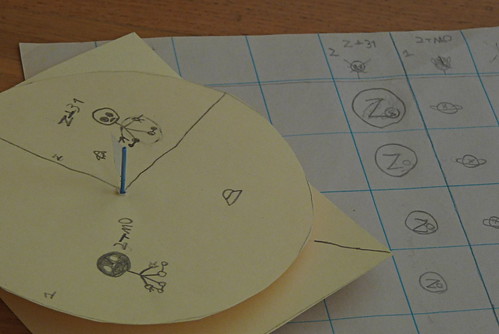
Anyway, Mr. T made a spinner. The book instructed kids to make a spinner that was one-quarter red and three-quarters blue. Well, I know Mr. T, so I told him he could make any categories he wanted on the spinner. When I said, “Even characters, if you want to,” little fireworks practically shot out from his eyes.
He drew an alien in each of the two spinner sections, and named them 2-MO and Z-31. Actually, he didn’t use dashes; he drew sort of a flattened T symbol for one alien, and an upside-down version of the same for the other. When I asked what the symbols meant, he just rolled his eyes and said, “They’re aliens.”
Oh.
The book’s design for these spinners is pretty brilliant. You basically use some 4-by-5 index cards (I used cut-up manila folders ’cause that’s what we had). You draw a line from one corner of the bottom card to the center of it, which indicates which part of the spinner “wins”. Then you poke the bent spoke of a paperclip through the bottom card and the round spinner, and tape the rest of the clip flat to the bottom of the card; a little flag of tape will keep the spinner from flying off the card. But the secret mechanism is a one-quarter inch cylinder, cut from a drinking straw, which goes between the bottom card and the circular piece. That makes the spinner really spin, in an obsessively fun way. Like a record, baby, round, round, right round.
The fact that the spinner featured aliens made testing it all the more fun. Filling out the results graph became a race between aliens. Of course, Mr. T didn’t want to just color in or put an X in the graph paper squares–he wanted to draw each alien’s personal planet in his square whenever the spinner landed on his spot. Which was fine by me; graphic graphs are more fun to look at anyway.
Poor Z-31 was pretty much doomed from the start, getting only one-quarter of the space on the spinner and all. Plus, luck wasn’t on his side: out of 22 spins, the spinner landed on 2-MO eighteen times, and Z-31 four times. Which led to a conversation about how chance factors into probability.
We’ve been talking about probability in terms of game design. Mr. T is still making his own Pokemon-style card game called Dinkers; until now he’s planned for players to use dice on their turns. But he’s starting to see how spinners give the game designer more control. If he wants a rare outcome, he can allot it a very slender slice of the spinner’s pie. Plus, you can make a spinner have words and pictures and personality.
But mostly, spinning a spinner is just dang fun.
That looks like so much fun. Going to try it now. I love how Mr. T personified the portions of the spinner—so much more exciting. I can’t remember–are you a Radiolab fan? Their episode called Stochasticity (on probability) is great.
I haven’t ever listened to Radiolab, but I know you’ve mentioned it. Yay. Now I have a new podcast to listen to later, and I’ve learned a new word. Sto-cha-sti-ci-ty.
Jon Bon Jovi and Eddie Van Halen live together in New Jersey with the lead singer from Dead or Alive. I thought everybody knew this.
Oh, good going, you jokester. Now I’m going to get Dead or Alive fans showing up at my blog. Just yesterday, according to my blog stats, someone came looking for Stryper because of that Bon Jovi post.
What the heck, all you Twisted Sister fans, why don’t you stop by too? Come hang out with some homeschooling mamas! Come on, feel the noise!
Cool. I love his variation. I’m going to have to check out this series…
It’s good stuff!
have you heard the new version of that song? “when you go down, when you go down down.” oh my, i hate the new version! one of these days, i just know my kids are going to go, “oooohhhh – now i know what that song was about.” kills me. hope your kids don’t read these comments. sorry.
our boys will love each other. they can talk about aliens (my son is a firm believer). he loves to google alien images. we made spinners too, from the family math book. used a cereal box and a paper clip. pretty dang incredible!
Well, I’m an old lady in my 40’s, so I assure you that I was referencing the ’84 Dead or Alive version. I didn’t even know there were other versions–that’s how much of a dork I am. No nasty new versions for me, thank you very much.
And speaking of probability, I think it’s pretty unlikely that my teenagers are reading the comments on my blog. They probably have at least a zillion other things they’d rather do with their time. And Mr. T doesn’t have internet access. (Although the wiseacre above was my husband.)
Can’t wait to watch our boys bond over aliens.
Great title and song. I liked when you repeated the lyrics to it in the piece because I was already singing them in my head and then your words seemed to match where I was in the song.
This is a helpful post because you explain your process so well and Mr. T is so lucky to have you as a Mom because you are flexible when it comes to his learning; you adapt it to his interests flawlessly. I could just picture his eyes bulging at the possibility of drawing aliens.
I have to say, the song kind of creeped me out when it was popular. The guy’s voice was so whiney; he reminded me of the childcatcher in Chitty Chitty Bang Bang.
Check it out:
http://www.youtube.com/watch?v=mCiVXigrjjQ
Creepy! But you’re right: once the song is in your mind, you can’t get it out!
Thanks for the kind words about the process. I wish I could say I adapt to his interests flawlessly–it’s actually often a struggle. But adapting to the kids’ interests is always my goal.
Brilliant. Don’t you just love those little-firecrackers-shooting-out-of-their-eye moments? And (borrowing your words again) I am squirreling this away for future use!
If you’re squirreling it away, does that mean I’m a nut? 😉
Patricia, could we do a little email exchange about these Math Solutions books? You have me intrigued, but when I looked at the website, there were so many choices, I wasn’t sure where to start, and you could spend some serious money fast. Any books you’d especially recommend for an almost-7-yr-old with very little formal math experience but a decent beginner’s grasp of addition, subtraction, and multiplication (mostly from playing lots of Monopoly)?
If you don’t mind taking time from reliving the glorious hits of our youth, I’d sure appreciate some boring old curriculum critiquing. Thanks!
Carrie, I decided to respond in the comments, in case other people might be interested. If you want to chat more, please feel free to email me.
I changed the Math Solutions link above, to one which makes it easier to find the books I’m talking about. The link now takes you to an index that allows you to browse by title. Look for titles that start with “Math by all Means” or “Teaching Arithmetic”. Both of those series use a similar format.
The website has sample lessons from the books, so you can see if the books would appeal to you. If you click on any of the titles, you’ll get to a page for the book, which usually includes a “lessons” tab. Click on that and you’ll get sample lessons from the book, often more than one.
The lessons are definitely geared toward classroom teachers; I often read through a lesson and then adapt it for my kid. I’ll simplify it, or give Mr. T more freedom with what he can do, like he did with the spinner above.
Even though the lessons are wordy, I think you can learn a lot by reading through them, especially if you’d like to learn more about teaching methods for math. They help you see what’s important to look for in your kids’ math thinking, beyond the rote memorization that I remember from my childhood. Even the “Teaching Arithmetic” books are about comprehension over memorization.
For B., I’d try any 1-2nd grade book in either of those series. The geometry and probability ones are both fun. The only one that seems a little silly for homeschoolers is the money book! I’m betting they get plenty of real-world experience with that.
If you’re interested in reading more in depth on sound math philosophy, the book About Teaching Mathematics is a classic and very good. It has lots of lessons for kids grades K-8. I think it’s better as an overview. The lessons are so wide-ranging; I find it easier to use one of the other books with lessons clustered by age and topic.
Also, the “Minilessons for Math Practice” books are good for homeschoolers. They’re designed to be quick lessons that take just 5-15 minutes, and are often mostly conversational. For us, that’s often plenty for a day!
You can often find these books used online. I also just got a discount code from Math Solutions for 20% off of a $50 or more purchase, until 10/31. The code is 9GBP7.
Phew, that was quite a ramble. Hope it helps!
Oooh! Can we make spinners at our next creature club meeting?
Carrie
Sure, if the kids are up for it! It’d be fun to see how they’d want to divvy up the spinners, if they were planning to let different creatures “race”.
Hi there,
I came over from A Foothill Home Companion…you have a really great blog! I will stick you in my favs and be back for sure.
Take Care,
D 🙂
Thanks so much for stopping by, Dawn. And it’s always nice to learn how people find their way here! (Molly is the best.)
Thank you, Patricia, for taking the time to respond in such depth to my question about the math books. You didn’t know you were going to be thrust into the “Answer Gal” role with this post, did you?
Thanks again!
I *love* sharing ideas and resources! Lori of camp creek http://www.whiteoakschool.com/
would say that’s a good thing: better to share with other parents than unleash my teaching tendencies on my kids!