the era in question
Dear fellow wonderer,
A few months back, when I interviewed Minna Dubin about her book Mom Rage, I asked about a line from the book:
When I became a mother, I didn’t know there was a grand PR narrative of Motherhood to buy into or resist. Intensive mothering had infiltrated the parenting world I stepped into so completely, I couldn’t see it.
I asked, “When did you become more aware of this grand PR narrative?”
Minna paused for a moment, thought. “Not until I was writing my book.”
Precisely. Often, cultural influences are so strong we don’t see them, and we only notice how they’ve shifted in retrospect.
There’s one cultural shift in particular that, once I spotted it, has simmered in my brain, sometimes bubbling up into my own distinct version of mom rage. Let’s talk about BabyCenter.
* * *
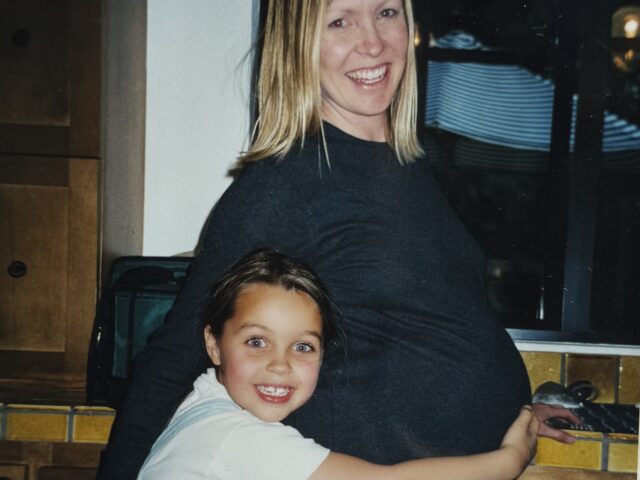
If you’re a mother who was once pregnant, did you subscribe to BabyCenter’s emails? I did, with my third baby, in 2001. Worth noting here: I had not subscribed with my two older kids. When they were babies, BabyCenter did not yet exist.
If you did subscribe, maybe you remember the weekly ping in your inbox telling you your baby’s size via terms of fruit. One week your baby was the size of a coffee bean; a few months later, a pineapple!
Did you know that BabyCenter was started in 1997 by two Stanford MBA grads, two guys not yet parents? Brainstorming ideas for companies, Matt Glickman, one of the founders noted:
…having a baby is the biggest, most important, most fun life event and one that we can be really successful with because it is a big, fragmented market, people are relatively price insensitive, and they have tons of questions.
(That bolding is all mine.) Since new parents were, apparently, “relatively price insensitive” and had “tons of questions,” the two Stanford MBA grads “decided to meld editorial content and commerce.” They rustled up $13.5 million in venture capital funding.
For some perspective, when that article was published in 1999, online commerce–then cutesily called “e-tail”–comprised, if you can believe it, only one percent of retail.
“In October 1998, BabyCenter.com added an online store to its site.” Here we go! Let’s look at this notion of melding editorial content and commerce. More Glickman:
There were information providers—doctors, books, and magazines— and there were retailers who sell products. But no one put the two together… Our approach was going against conventional wisdom in many ways. People asked ‘how can you sell product and have your information be unbiased and objective?’ We are proving that consumers seem okay with that.”
No one put the two together. An approach that was going against conventional wisdom. We are proving that consumers seem okay with that.
Maybe “consumers” were okay with that. Or maybe they didn’t see the cultural shift underway.
* * *
Why did I sign up for BabyCenter’s emails? By the time I got pregnant with my third kid, I’d been a mother for nine years. I did not have tons of questions about how to mother a baby. I suppose I just typed in my email address because I could. It was interesting to have those emails ping into my inbox, telling me my baby was mango-sized, so I could pass that fun fact along to my two older kids. Also, that maternity swimsuit at the bottom of the email was way cuter than the ones I’d worn with the other two.

Pretty sure I bought this dress via a BabyCenter link
* * *
Around the time of BabyCenter’s founding, a ruckus arose elsewhere around this notion of melding of expertise and commerce. In 1999, one parenting “expert” of the time, John Rosemond, wrote a series of columns, published “in more than 100 newspapers,” calling delayed potty training a parenting choice based on “Freudian mumbo jumbo.” He believed that once a kid turned two, you should let them run naked for a few days and chase them down with a potty.
He took issue with experts who believed parents should follow the child’s lead on potty training, namely pediatrician Dr. T Berry Brazelton, who said at the time, ”Don’t rush your toddler into toilet training or let anyone else tell you it’s time — it’s got to be his choice.” But as Rosemond noted, Brazelton spoke these words on a commercial for Pampers size 6 disposable diapers.
The complications deepen. Consider an AdWeek story from those early internet days of 1997: “Procter & Gamble’s race for parents’ online eyeballs is shifting into high gear. A major overhaul of a site supporting Pampers, called Pampers Parenting Institute, will go live at the end of the month.”
(Note that term: shifting.) Guess who Procter & Gamble, in their race for parents’ online eyeballs, named as chairman of the Pampers Parenting Institute?
Dr. T. Berry Brazelton.
“‘I think it’s a fairly blatant conflict of interest,” Rosemond said at the time of Brazelton’s Pampers ad.
Now I’m no fan of Rosemond, never read him at the time, and I seethe at his tone, how he assumes potty-training is a mother’s job: “When they have an accident, they stop and start to howl, and the mother comes along and says, ‘Well, you forgot to use the toilet.’ She puts him on the toilet, wipes him off, speaks reassuringly to him.”
Still, he was calling out a shift in those early internet days: parenting “experts” were now going online, aligning with commercial interests. And the stakes, thanks to the new rise of venture capital funders who could dish out $13.5 million to a couple of recent Stanford MBA grads, were amping up as never before.
“How can you sell product and have your information be unbiased and objective?’’ people asked BabyCenter’s founders.
* * *
After my third kid was born, the BabyCenter pings kept coming, weekly, telling me what he ought to be doing. Drooling or rolling over or starting to support his weight on two legs—that last one linked to several baby jumpers I could buy. (I did not.)
I’d already been a mother for almost ten years at that point. I didn’t need advice and, anyway, I had no time for it, busy as I was with not only a baby, but a nine-year-old and a six-year-old who had already kept me quite occupied before their brother showed up.
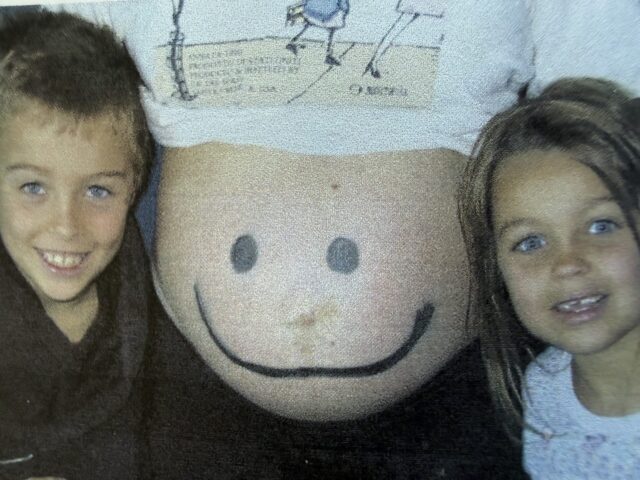
I don’t know why I let those BabyCenter emails keep pinging into my inbox–this was long before I learned to turn off notification sounds–with their unneeded advice and their links to crib tents and breast pumps and a Slumber Bear that “emits womblike sounds.”
Only a click and a credit card away.
* * *
It’s not just BabyCenter’s origin story that riles me up every time it comes to mind, but also an old research study I discovered only recently.
In 2006, researchers in Scotland, at the University of Dundee, analyzed advice given on popular parenting websites in the weeks after 9/11. As I’m sure you recall, those were terrible weeks for most of us–and if you were a mother, the challenge was particular. We’d just been carrying on with our lives, trying to figure out when to potty train and how to sneak zucchini into spaghetti sauce, when suddenly planes came from nowhere, decimating people, and now we had to introduce terrorism gently to our children.
What’s fascinating is how these researchers scrutinize the language of the advice given to us parents in those post-9/11 days, revealing underlying messages lurking in the rubble. Consider how the online advice is presented as mere helpful suggestions, yet on 75% of the websites the researchers note a coexisting authoritative tone, commanding parents with words like must, crucial, essential. And while most experts note that children respond to situations differently, guess how many acknowledge variation in how parents interact with their children?
0%.
No, of these twenty popular websites, parents are homogeneously characterized as “generally unprepared and ill-equipped for dealing with an event of the magnitude of 11 September” and needing expert input on, get this, 90% of the sites.
And to really hammer this need for expertise, “parents are cautioned against acting on their instinctive reactions.” On 85% of these sites, experts blame parents, saying their ill-equipped choices will cause their children psychological harm.
Just look at those statistics! The message was clear: our intuition was wrong, we needed expert help, and if we didn’t get it, we’d screw up our kids.
BabyCenter is one of the twenty sites analyzed.
* * *
On September 11, 2001, I was eight months pregnant with that third kid. By this point I’m pretty sure I’d been mostly ignoring BabyCenter’s weekly pings (which would have likely told me my baby was now pumpkin-adjacent.)
At eight months pregnant, surely my emotions already simmered just beneath my skin, like my baby’s elbows, knees against my belly’s walls—and then the planes hit, the people leapt. My brain couldn’t process the TV screen that morning, couldn’t look from there into the eyes of my children. Of course I searched online for help on how to explain.
I don’t recall exactly where I looked, but given all the fruit metaphor emails, I’m guessing I went to BabyCenter.
* * *
When I discovered that the research study contains links to those top twenty sites and the specific advice analyzed, I clicked fast on the BabyCenter link to see what they told me all those years ago, in those post-9/11 days.
“This page may have been moved or deleted.” Damn. I try BabyCenter’s search engine. Nope, more than two decades later, this page is buried, gone.
Determined, I pull up the Wayback Machine, a digital archive. I click through multiple stored pages from that fall, through different sections, different links, only some of which still work. Half an hour slips past and then: “How to talk to your kids about Tuesday’s terrorist attacks.”
Bam! I read, “It may be tempting to say, ‘everything is fine, we’re far away from the explosions and nothing will happen to us,” which sounds very much like something I might have said to my kids. According to BabyCenter, my intuitive response was wrong.
Further down, I see precisely the authoritative tone called out by the researchers. “Right now, the best thing you can do is follow instructions.” What? Talk about undermining my mothering abilities, my own intuitive expertise!
Every time I read this line, I’m enraged on behalf of my young mother self, my mothering peers, all the mothers that have come after.
The research study is what got me digging into BabyCenter’s origin story. Those two young guys, BabyCenter’s founders, their $13.5 million venture capital raised. Suddenly I could see the bigger picture, the shift underway.
A new model at the millenium’s turn: websites combining expertise with commerce. With investors demanding profit, sites like BabyCenter needed us mothers to keep coming back, buy the stuff they were shilling. The best way to make sure we would: tell us we needed expert guidance. Make us believe we couldn’t trust our intuition.
Every week in my inbox: Ping! “What you need to do right now is follow instructions.”
* * *
I unsubscribed from BabyCenter’s emails decades ago. I wish I remember when. Something about those emails irked me–I do remember that. Maybe all the crib tents and Slumber Bears, stuff my lived motherhood told me I didn’t need.
Here’s the point I want to light up with my rage: something foundational shifted when the culture stopped questioning the melding of expertise and commerce. Soon after we’d have “mommy bloggers” with banner ads. Soon we’d have Instagram and momfluencers with sponsored posts and affiliate marketing, then parenting “experts” with backgrounds in economics, who make conclusive arguments based on data interpretation and who–along with other “experts”–offer paid monthly memberships for their increasingly complicated scripts and expertise.
Each and every one of these influences is out to make a buck. Each and every one has chipped away at and ultimately undermined our motherhood superpower: the ability to hear and trust our intuitive wisdom.
Why do I keep prattling on about this? Because I first became a mother in 1992 and I remember a different sort of motherhood. A motherhood with space to think, find my own way. I read books, of course I did, so many books, dutifully skimming my What to Expect books every month or so–but I could also ignore those books on my nightstand, like I’d ignored the What to Expect authors when they told me to tote at all times small flasks of wheat germ.
Mostly, I learned how to be a mother by being a mother. Seeing what worked with my baby, what didn’t. Trying again.
* * *
Look again at that Mom Rage line from Minna: When I became a mother, I didn’t know there was a grand PR narrative of Motherhood to buy into or resist.
There’s so much about today’s motherhood that we can buy into, literally and figuratively. But as Minna notes, we can also resist. If we see the cultural shifts at play, it’s easier to consider where we might push back.
Something to keep in mind about experts and influencers who make a living from advice and aspirational content: They need you more than you need them.
As always,
Patricia
If you’re local to the Bay Area, Storytime for Caregivers continues! On Tuesday, May 26 we’ll continue this riled-up vibe, I’m sure, as we chat with writer and activist Kate Schatz about her novel Where the Girls Were, set in 1968 San Francisco, in a home for unwed mothers in pre-Roe times, and based in part on Kate’s own mother’s story. Babies are welcome but not required. Sign up for free here!
Cross-posted on Substack.