Apologies for centering my picks–I needed a horizontal photo!
Dear fellow wonderer,
I keep hearing about parents wanting to give their kids a ’90s childhood or a ’90s summer and while I love this, it has me thinking: maybe what we really need is a ‘90s motherhood. A chance to be mothers in a space without so much outside influence, where we learn to raise kids in community—a relatively non-judgmental community—and via trial and error. 1
And where we learn, since we don’t have much internet, from books. Which brings me to my recent reading series event with Sarah Wheeler. Typically in this series, I’m in conversation with a writer about a book they’ve written with a parenting/caregiving theme. For this gathering I thought it might be fun to chat with Sarah about alternative parenting books, the books that actually influenced us as parents. Sarah came to mind partly because of her fantastic podcast with Miranda Rake, The Mother of It All (they interview the best writers on motherhood), and also due to a stack of books Sarah brought along to a parenting/caregiving workshop she offered here in Oakland at Local Economy. Her stack contained some of my own favorites—and they weren’t your typical parenting book fare.
Then I read Sarah’s essay Emily Oster Can’t Have It Both Ways. It’s a great place to start—it gives a sense of where we’ve landed with parenting books, all the endless advice about how to maximize kids. Our conversation started and departed from there.
Sarah brought five books that changed her motherhood, and I brought five that changed mine. It was such a fun, inspiring conversation. If you’re longing for your own ‘90s mom summer, here’s some beach bag inspiration:
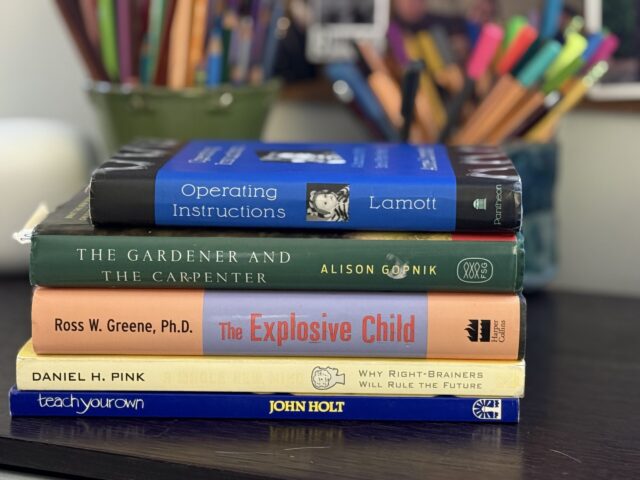
- Operating Instructions: A Journal of My Son’s First Year by Anne Lamott. We have to start with this 1993 pick of mine because this was the book that kicked off honest writing about motherhood. Back then, no one else wrote about being a single mother with a colicky newborn; no one else took to the page to call their baby “a little shit.” I remember being both shocked and consoled when Anne admitted that some colicky nights, she dreamed of throwing Sam down the stairs. I also remember how she described his hands “like little stars.” I went to Anne’s Berkeley reading for the book on my first (technically, there’s a story there) Mother’s Day. It’s an essential book that still holds up, despite the very ‘90s references. (Rereading in preparation for the series, I cracked up at her wrath at Bush, realizing she was referring to George Bush Sr.) This book kicked off thoughtful online writing about motherhood, starting with “Mothers Who Think” at Salon; it led to the honesty of “mommy blogging” before that got diverted, so unfortunately, to the aspirational content prevalent today.
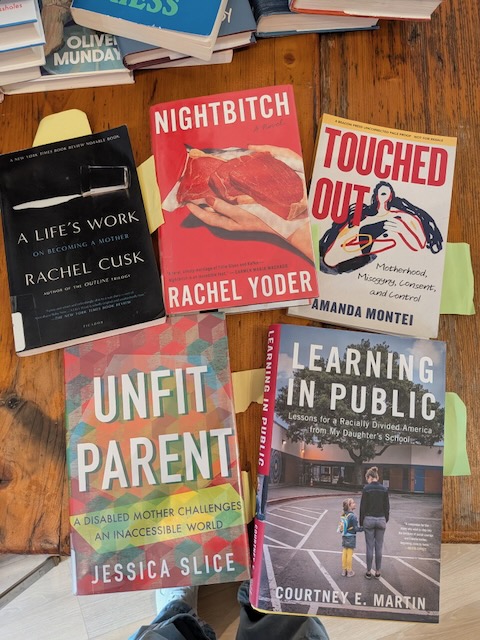
- Which brings us to Sarah’s first pick: Touched Out by Amanda Montei. Published 31 years after Operating Instructions, Sarah loved this book for precisely the reasons I loved that one: its honest depiction of motherhood. Sarah shared how the book described complicated motherhood feelings she’d never seen or heard discussed elsewhere. (And if you’re local, Amanda will be our guest in September at Storytime for Caregivers at Local Economy!)
- I was surprised, when sharing Learning All the Time, that no one in the room had heard of John Holt. Holt was a teacher who wrote about reforming schools to make them more developmentally appropriate for kids; when reform didn’t come fast enough, he became an early advocate for homeschooling—how I first discovered him. As a former public school teacher myself, Holt’s writing on how kids really learn blew my mind and gave me confidence to be more guide and observer, rather than teacher. Learning All the Time isn’t a homeschooling book—though I can’t find my copy, so Teach Your Own is pictured. Learning All the Time‘s subtitle says it all: how small children begin to read, write, count, and investigate the world without being taught. Highly recommend as a mental reset if you’re someone who feels you should be doing more to prepare your kids. Fun side note: Austin Kleon’s new book Don’t Call It Art: 10 Ways to Create Like A Kid Again, was influenced by Holt. Austin writes about how he made a pandemic project of reading Holt’s Growing Without Schooling newsletters, and tweeting out a favorite bit each day.
- Sarah returned to the theme of motherhood honesty, sharing Rachel Cusk’s A Life’s Work. I apologize for not having detailed memories of what Sarah loved best about each book—should have taken notes!—but I know she appreciated the intelligent discourse here. (I admit that when I tried reading this book many years ago, its honesty veered into a sort of negative prism I couldn’t get past. Every book isn’t for everyone.)
- One book that influenced my parenting is not a parenting book at all—it’s, of all things, a business book: Daniel Pink’s A Whole New Mind. It’s a book about how needed skills for the future are not the left-brained ones previously valued—logical, linear skills—but how, as noted in the subtitle, “right-brainers will rule the world.” The abilities Pink delves into are design, story, symphony, empathy, play, and meaning. Crazily, though the book was published in 2005, it seems more prescient than ever, given the rise of AI. As a mother, the book helped me grasp that so many of the “fun” things my kids were undertaking on their own were not just pastimes, but endeavors preparing them for their futures. Back in 2010 I dug into how these abilities were playing out in my kids’ lives, and sixteen years later, all three grown, I’ll vouch for the notion that these abilities have guided them into adulthood.
- Sarah read next from Night Bitch, which you should definitely pack in your book bag if you’ve somehow missed it. It’s a fictional approach to conveying the honest reality of motherhood—savage, uproarious, fun. If you’ve only seen the film, Sarah says the book is, ahem, a different animal. A summer read that will have you longing to lope off into the night.
- I read Alison Gopnik’s The Gardener and the Carpenter when it was published in 2016, just as my youngest was heading off to high school, so it didn’t so much influence my motherhood as affirm that, despite all the challenges, in learning to trust my gut, I’d gotten a lot right. Gopnik looks at human evolution and her own research on how kids learn to question current standards for parenthood—how we’ve come to believe our role is creating optimized children as if we’re building the perfect chair, when we might do better by nurturing our kids like gardeners. Allowing for uncertainty as we watch that seedling sprout—what is it?—and tending to it nevertheless, loving it, offering what it needs to thrive, and waiting to see what blossoms. The Gardener and the Carpenter helped me understand the point of the manuscript I was just beginning to write, the story of my never-ending struggle to beat down my inner carpenter (a public school teacher with lesson plans!) to become the sort of gardener-mother I wanted to be, so my kids could evolve into the people they wanted to be.
- A book that helped Sarah learn to trust her intuition was Courtney Martin’s Learning in Public. Sarah counts Courtney as a friend—lucky duck!—and as a former teacher and school psychologist, she was deeply influenced by Courtney’s questions and decisions about school choice. In the book Courtney researches local Oakland public schools, coming to understand that White families mostly avoided her neighborhood school due to low ratings and a primarily Black population. Courtney’s decision to send her daughter to the school raises larger questions about democracy and the actions we take as parents—and her decision encouraged Sarah to send her own kids to the same school. My kids were grown by the time I read Learning in Public but I relished it for the questions it raises about choices in education. (Courtney recently joined Storytime for Caregivers to discuss multi-generational caregiving. Hope to get her back to chat about Learning in Public!)

Everyone in the crowd loved Sarah
- An influential book for me that Sarah brought along as an “extra” is Ross W. Greene’s The Explosive Child. I didn’t bring the book as a universal recommendation—it’s about understanding “easily frustrated, chronically inflexible children,” which surely doesn’t widely apply—but because it taught me, yet again, to trust my intuition as a mother. In this post about my ire for “gentle parenting,” I wrote about how The Explosive Child helped me see that I’d intuitively learned to interact with one of my kids in a way that went against cultural norms, based on what I sensed he needed—and that my gut had steered me in a productive direction.
- Sarah raved about Jessica Slice’s Unfit Parent—a book I’ve not yet read—for how it opened her mind to the experience of parenting with disability. She also claimed that The Mother of It All episode with Jessica might be her favorite of over 100 recorded episodes—wow. A great place to start if you’ve not yet read the book.

Sarah’s bonus books

And mine
Bonus books! Neither Sarah or I could stop at five so we brought extra recommendations—sometimes the same recommendations. We both loved Amanda Hess’ Second Life for its dive into how technology has wormed its way into parenthood (though one series attendee said the book made her feel weird about using phone tech during her pregnancy.) Sarah brought The Good Mother Myth, Nancy Reddy’s fascinating history of (mostly male) parenting “experts”; I brought the inspiring collection of motherhood poetry Nancy co-edited, The Long Devotion. As a satellite to Holt’s work, I brought Lenore Skenazy’s Free-Range Kids—essential reading on giving kids more agency and independence. Clare Dederer’s hilarious motherhood/yoga memoir Poser—a book I also loved—made Sarah’s extra stack. One of my favorite motherhood-themed memoirs is Irish poet Doireann Ní Ghríoffa’s A Ghost in the Throat for her refreshing embrace of motherhood paired with an impassioned intellectual quest: unearthing the hidden life of a forgotten female poet. Consult Sarah’s photo for even more recs!
Finally, I had to include You Are Your Child’s First Teacher by Rahima Baldwin, a book so old that the author seems to sport a mullet on the back cover (back in those days when no one cared what authors looked like or ate for lunch.) This book has a lesson for me about the reading of my own ‘90s motherhood: the few parenting books I kept were the ones I loved. We weren’t being hammered, back then, to optimize our kids, so the books we picked up were somewhat random. And the ones I kept, the ones that stuck with me, weren’t books that provided a lot of answers—instead they were books that reinforced what I already sensed inside as a mother. They fed my intuition and encouraged me to keep going. Something that was easier to do without endless internet distraction.
Scanning Sarah’s list and mine, the pattern repeats. The books that have had the most impact have not, for the most part, been prescriptive. Instead, we’ve held on to stories of people who make us feel less alone. We’ve embraced texts with big ideas that helped us think differently.
An antidote to the mad rat brain of algorithmic input: focus on a book. Maybe read the jacket copy and choose one that doesn’t make promises. Pick one that makes your brain spark or one that makes your heart shimmer in recognition.
As always,
Patricia

To go with the ‘90s reading vibe, of course we had little zines!
P.S. If you’re local to the Bay Area, this month’s Storytime for Caregivers promises to light up your brain. I’ll be chatting with Darby Saxbe, PhD, psychologist, brain researcher and major dad fan about her book Dad Brain, which explores how becoming a father changes men, from their bodies and brain architecture to their hormones and sense of purpose. Babies welcome but not required—and dads are especially welcome! Register for free!
Cross-posted at Substack.
1. I’d love to pitch an article about why a “’90s motherhood” might be a worthy aspiration. Anyone know an editor who might be interested?