Dear fellow wonderer,
Back in August, I went to Amoeba Records in Berkeley and bought a copy of Phoebe Bridgers’ new album Lost Weekend on its release day. While Chris and I have been adding to our record collection for years, I haven’t bought a physical album on its release day since I was a teenager in the ’80s. (My last before switching over to CDs was likely the 45 of “Do They Know It’s Christmas.” Check out all that hair!)
Phoebe’s album is so cool—my edition glows in the dark! There’s a chapbook-like collection of lyrics. And when I was looking at the album cover in the light of the window, I noticed some texture: the embossed credits for a secret song. Sure enough, when I played the seemingly blank fourth album side, there it was.
But what I love best? Since I first played this album in tangible form, I came to learn it in that form. When the song “Bobby” ends, I know it’s time to flip the record. And I think about that, even if I hear the song via streaming.
Like back when I was a teenager, my fingers tingle, knowing there’s something they should do.
* * *
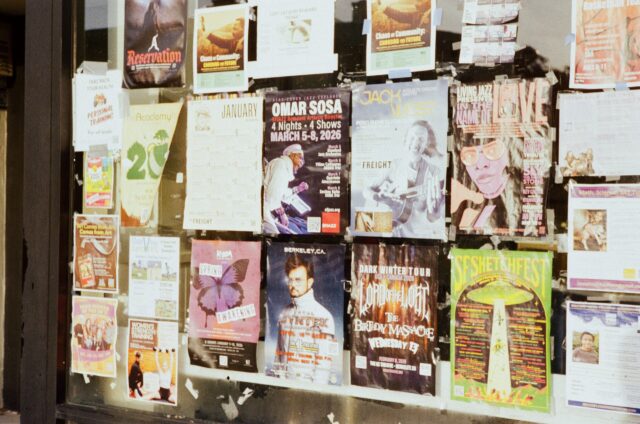
I’m encouraged by how young people are longing for the tangible. They’re shooting on film, buying records, making zines. I enjoyed this longform piece at n+1 on twentysomethings in New York City aiming to get off their smart phones. One “lamented how much Big Tech had succeeded in wiping out the old architecture of independent culture: alt weeklies, local papers, record stores, bulletin boards, magazines, event calendars, and small publications devoted to subculture and scene.”
The very architecture I grew up with. All those places and things you could inhabit and touch. Here’s what these young people did, throwing their Summer of Ludd: “In keeping with their low-tech ways, they would not advertise on social media. Instead, they would be wheatpasting, flyering, and publicizing a hotline that anyone could call for information.”
Keeping their hands busy.
* * *
I got the coolest little vintage Rollei 35S film camera for Christmas. It’s as small as a camera can be while containing a roll of film.
Film photos are so evocative. They have a depth and imperfection you can’t get digitally. Even the mistakes become art.
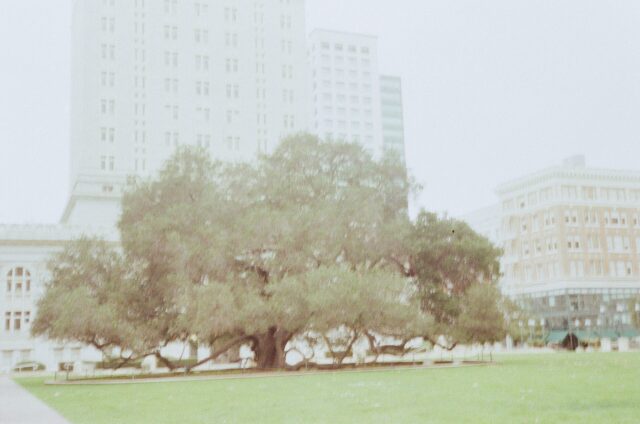
Using my Rollei has changed the way I take photos. I take fewer. And if I screw up the shot—oh well! I find myself opening my phone camera less. I don’t want so many photos. It’s just clutter to weed through. I want fewer; I want the ones I take to count.
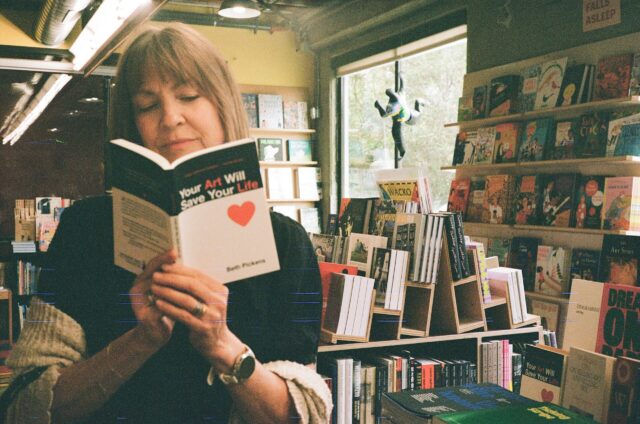
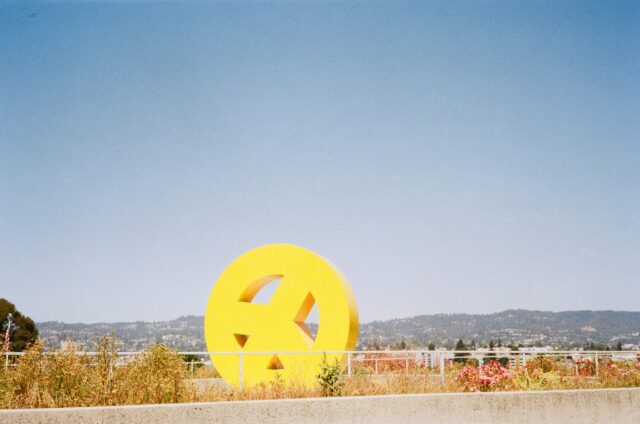
The photos here are Rollei shots.
I love the feel of this little camera in my hands.
* * *
Have you listened to the podcast How to Touch Grass? The final episode, with Jenny Odell as guest, really struck me. They discuss how “in one 2025 study, researchers found that blocking the internet on people’s phones for two weeks led to improvements in sustained attention equivalent to reversing 10 years of cognitive decline.” Wow! Then one of the hosts replicates the study in her own life—listen and see how it turns out.
A line that stuck: “I wanted to stop nickel-and-diming away the moments of my life.”
I like my brain. I like the idea of helping it work better. I’m not going cold turkey and blocking my phone for two weeks, but the episode has inspired me to pick up my phone far less. I’ve been checking email and social media approximately three times a day; I’ve given myself a 15-minute limit on Instagram.
It’s interesting how after a few days of this, the urge to pick up my phone, to open my email or Instagram has faded. I’ve been toting around a book for when I feel the itch to look at something. Last week I stood in line for twenty minutes for Cheeseboard pizza and did not touch my phone. I read from Enshittification instead, which turned out to be the perfect text to make me despise my phone, and let it linger in my bag.
Odell offers so many gems throughout this episode. I love how she’s come to see her phone as a tool. She uses it in a limited way, to do something that only the phone can do: for the Merlin app, for i-Naturalist, to read the constellations, to take notes. The phone becomes a tool to help her interact with the tangible world.
* * *
Odell talks about taking some time to dig into what compels you to be on your phone so much. I’d been doing that already, writing about this in my journal. I’m not much of a scroller. Instead—and this is embarrassing to admit—I go to social media for affirmation, especially if I’ve posted something. But in thinking about this, I realize that I’ve made a professional life for myself—as as a writer, a blogger, a newsletter writer—by simply putting my stuff out there. Most of this hasn’t been work for pay or for an expansive audience; the only way I get any sort of validation for my work is via comments or (the far less satisfying) hearts and likes and views.
Back in my early blogging days, the comments section helped me see that my work made a difference to a reader. Comments were so much more common in that 2008-2012 era. We weren’t yet zombified by Facebook, then Instagram, weren’t yet trained to tap hearts rather than engage in a conversation.
I guess part of me keeps longing for that conversation, that affirmation. I’d gotten in the habit of picking up my phone again and again throughout the day. I was hoping, I’ve come to realize, for a comment, a DM, a hopeful email or something that felt like some sort of good news.
Newsflash: good news was rarely there.
It feels really good to be training myself out of that habit. Feels so good that the transition to a less phone-dominated life hasn’t been hard. It’s been invigorating.
* * *
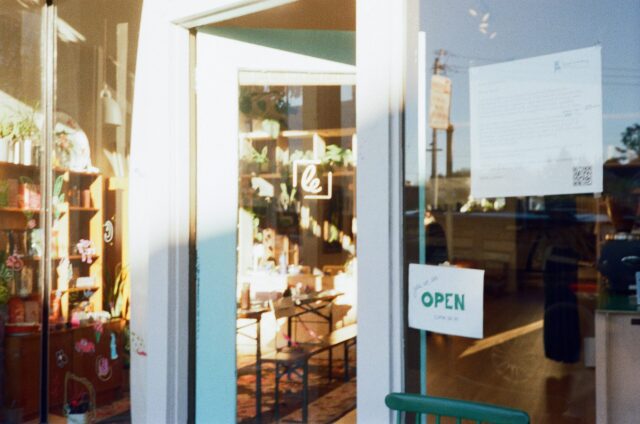
Speaking of the tangible, what has been feeding me is my monthly reading series at Local Economy. It’s a completely different experience, discussing the sort of ideas I’ve been sharing in my newsletter, in a room full of actual people. A room full of smart, curious people, mostly parents and caregivers. And babies! And riveting, provocative writers!
I feel no need for affirmation when the reading series is underway, or while chatting after the event. Being in communication with real people satisfies so deeply. We know this; it’s what those twentysomethings in the n+1 article are longing for. We know we need in-person community but there are so many reasons not to make it happen. The busy-ness of life, the endless requirements and expectations.
But when we rally ourselves to do it, it feels so good, right?
* * *
Most months for the reading series, I make tiny zines for the audience. It’s a ridiculous task I’ve added to my organizing and hosting responsibilities—but I can’t stop myself, ’90s mom that I am.
I make the zines to list the writers’ contact info. And, selfishly, to share a QR code for my newsletter, my website. But mostly, I want to offer these young parents something tangible.
Each month as I crease and fold the next batch of zines, I always leave a few pages blank, just lines. Space for attendees to take notes, I say, to write down each other’s contact info. This audience is mostly of a different generation, more likely to use their phones for such tasks. Still, every month in my basket of toys for the babies, I tote along a jar of pencils.
I suppose I’m toting hope in that jar. A silent belief that something might happen if these young parents set pencil to paper. If they jot down a writer’s quote that calls out, if they record contact info of a potential confidant, their intuition might spark. That’s what I want most for them.
* * *
A few years back, the artist and writer Lynda Barry bemoaned the fact that these days her college students don’t know how to cut a circle from a piece of paper. She’s watched this change play out in recent years, says about her students: “They don’t have a big relationship to their hands.” [NYT gift link]
This makes me so sad. Especially as an elementary teacher of long ago, before the No Child Left Behind act passed. Back then, art was part of every subject! My students cut paper throughout the day: to make fractions kits during math time, to make elaborate dragon masks for lunar new year, to crease and fold the very style of tiny book that I now make for my reading series.
There’s finally some pushback to get school kids off screens in the classroom. I’m not just talking about taking their phones; I’m talking about them learning by tangible means. See The Digital Delusion by Jared Cooney Horvath for why learning away from screens matters, and the brand new Coding Kids by Natasha Singer for how this whole mess came to be.
We fret and fret about our kids spending too much time on screens, but if we want them to value the tangible world, we need to let them live in that world.
* * *
I’ve been thinking about the simple brilliance of Dolly Parton’s Imagination Library project. It’s not some complicated program based on the latest data-driven theories about how to help kids learn to read—to which there’s inevitably some fiery counter-theory. Nope! It’s a program that simply puts compelling books into kids’ homes—and hands.
You’re likely already aware, but the Imagination Library mails books to kids homes, every month from birth until the age of five.
Just think of what that might do. A book comes in the mail; a busy parent might think: I’ll read this book to my baby. These parents might not have money for books, or time for library trips. But here’s a book; why not read it? The books keep coming and a habit forms: another book, let’s read together. Books keep coming in the mail: gifts. These books are gifts. Month after month a message might build in a kid’s mind: books are special.
If that’s a foundation for a kid, consider what might happen if that kid has continued access to a good school library, a helpful librarian. But alas, we know what’s happening to school libraries.
And the same is happening with Dolly’s Imagination Library. Many states don’t participate in the program, and for the ones that do, many are slashing funding.
It’s so short-sighted, an ignorance of what’s obvious. If you want kids to read, stop spending millions chasing down the latest “science-backed” textbook program—this path has only created a generation less likely to value reading aloud to kids. I’ve previously gone off on this snake pit.
If you want kids to read, start with the books. Put quality books in kids’ homes, in kids’ hands.
* * *
Which makes me think about audiobooks, one of my favorite techniques for lazy parenting, favorite alternatives to screen time. Research tells us that audiobooks can teach vital skills better than video content can, and often better even than books can. Improved comprehension, expanded vocabulary! In that post above where I go off about reading, I share more on what I’ve seen kids glean from audiobooks, as a parent and a writer’s workshop facilitator. And to back up that research on expanded vocabulary, I recall a few words and phrases my daughter plundered from audiobooks and dropped into conversations at five or six: sodden and perplexed and you have a severe lack of moral stamina. (!)
And to tie this to the tangible, I think about how, while my kids endlessly listened, their hands were often busy. Building with LEGOs, sketching creatures, crafting gifts for friends and grandparents. Or simply getting their whole bodies involved, pacing circles while they listened, thought, envisioned.
Audiobooks as an antidote to screen time works for me, too. I don’t count audiobook-listening as phone-time, but an alternative to scrolling. I listen while I knit, or cook, or drive, or clean, or work in the garden. While I’m doing something in the world.
* * *
Like everyone, I worry about kids today and their compulsion toward the digital world. But I have hope, too. A few weeks back, my niece, mother to a one-year-old, told me about her baby’s Yoto Player, which sounds like a fantastic entree into the audiobook world. The story of its design [another gift link] is inspiring too—Paul McCartney is an investor!
My niece said she’s very careful with screens. In her professional life she works with kids, so she understands the potential issues. And speaking of the tangible, consider what she told me: “You don’t want to put screens in kids’ hands. It makes them feel they’re theirs to control.”
Interesting.
I’m thinking about how some people are bringing back land lines for their kids and Tin Can phones. I’m thinking about how my daughter and her friends are talking about ways to put their phones away, hang them up, make them more like land lines. I’m thinking about how my teacher friend Adrian plays records in his classroom. How my friend Sarah has a project called Paper Choir, sending out an engrossing, gorgeous zine at the start of each season, and how the most recent one came with a sticker that says, LET US LIVE IN THE REAL WORLD. And now I’m back to Phoebe Bridgers, thinking about her upcoming tour, how it will be phone-free.
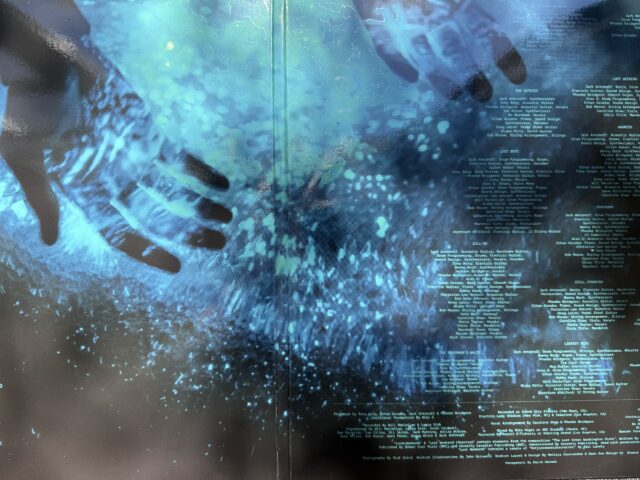
The inside of Phoebe’s album cover, taken with my phone. Hands.
Might there actually be a future in which we spend less time on phones, more time in the tangible world? Are you making this happen for yourself, in ways large or small? I’d so love to hear what you’re doing.
As always,
Patricia
Cross-posted at Substack.