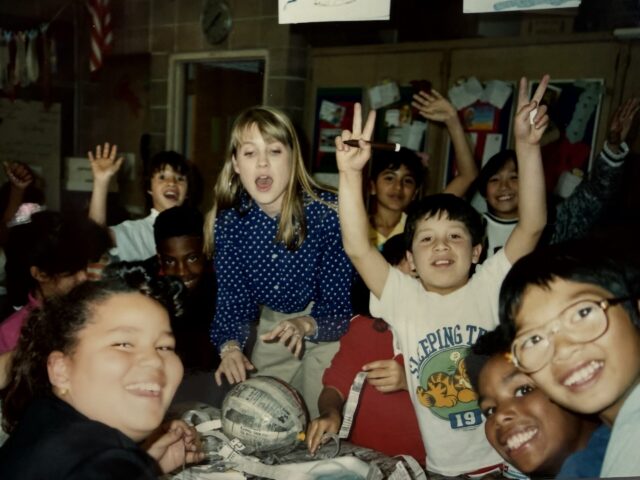
student teaching, 1989
Dear fellow wonderer,
You know, it’s interesting to me, the title of the podcast Sold a Story. Interesting because that’s the aim of a podcast: to sell a story. Good storytelling, I’ve learned as a teacher of writing, is all about the order in which you reveal information, and what information you choose to include. It’s about including sympathetic characters and just the right dialogue to make your point, and cutting the rest. It’s about the confidence of your voice and whether your reader—or listener—finds that voice authentic, and becomes willing to go along with the story you’re telling.
I’ve hinted at my issues with this podcast in the past, but have never really delved into it. So much of the content seemed inaccurate to me as a former teacher, and felt like a slap. How made it the case that phonics instruction is the only effective way to help kids learn how to read, and that it’s been mostly absent from schools for decades. How it pilloried literacy educators like Lucy Calkins, and paints teachers who followed those educators like fools who had fallen for a cult. (I’ve learned much more about the series since then; stay with me.)
Calkins hadn’t started writing curriculum when I was a teacher in the early ’90s, but her first book, The Art of Teaching Writing, changed my life. With her guidance, I started a daily writer’s workshop in my third-grade classroom, allowing my students to write on topics of their choosing. We learned to listen to each other’s work, to offer feedback, to discuss qualities—regardless of genre—that made writing effective.
I attended a six-week summer institute at UC Berkeley to improve my skills as a workshop facilitator, then voluntarily gave a Saturday morning each month to sessions of further support and guidance. Later, I’d spend years facilitating writing workshops for kids of all ages, becoming ever more convinced that if you allow young people to write about what matters to them—regardless of genre—they’ll become, with guidance, adept at all manner of storytelling, whether that be for academic papers or podcast scripts. (Such a zealot I am for the potential of workshops, I even wrote a facilitation guide for parents.) I can’t recall how many students and parents have reported back a college professor’s delight at their writing skills. And we’d snort amongst ourselves, knowing the kid picked up those skills writing fan fiction based on the Twilight novels, or a saga about a chain-smoking, bargain-loving fish named Mama Trout.
* * *
I’m writing this now because Sold a Story just launched a second season, and I believe this season is selling an even more dangerous message than its first. By dangerous I mean that a singular perspective, by virtue of storytelling skills, manages to become a dominant cultural perspective.
A quick encapsulation of the first season’s argument, and what happened next: Sold a Story Season 1, titled How Teaching Kids to Read Went So Wrong, makes a case for what has come to be known as the “Science of Reading,” a term adopted by those advocating for a systemic return to the teaching of phonics as the primary method of teaching reading. The series argues that science, for decades, has strongly supported phonics as the correct way to teach children to read, that other methods have been “debunked,” and that the science has been settled. It claims that the teaching of other methods has led to lower reading test scores and has harmed children.
Released in late 2022, Sold a Story, Season 1, has won multiple prestigious awards for its storytelling, has been downloaded more than 16 million times, and is one of the most downloaded Apple podcasts for three years running. The series spurred massive, unprecedented change in education, with states and school districts passing new laws and purchasing new programs that supported the “Science of Reading.” Nick Covington of The Human Restoration Project notes:
In May 2023, the mayor of New York City announced “a tectonic shift” in reading instruction for NYC schools. First-year training for the new curriculum was estimated to cost $35 million, but “city officials declined to provide an estimate of the effort’s overall price tag, including the cost of purchasing materials.” NYC Schools also disbanded their in-house literacy coaching program over the summer to contract instead with outside companies to provide coaching.
The podcast’s website notes that Sold a Story has influenced policy change in more than twenty-five states. “It’s not just a hit podcast—it’s a catalyst for policy change, teacher training reform, and renewed attention on literacy.”
The most comprehensive source I know for fact-checking Sold a Story’s claims is Fact-Checking The Science of Reading, a deep-dive by two researchers from the University of British Columbia and the University of California, Berkeley. It’s an overwhelming document that digs into ten claims put forth by “Science of Reading” advocates; if you’re curious about whether science makes a solid case for phonics teaching, I urge you to delve in. Some shortcuts: On the claim that “explicit systematic phonics instruction is the key curricular component in teaching beginning reading” see pages 22-37. On the claim that other reading teaching methods have been “soundly discredited,” see pages 55-66. On the claim that these other methods are to blame for falling test scores, see pages 78-87.
To be clear, neither the authors of this report nor I are making the case that phonics should not be taught. Rather, I believe that phonics instruction should be one aspect, as needed, to a comprehensive curriculum aimed at helping students become literate.
* * *
Back to Season 2, and back to storytelling, since I believe that storytelling techniques are what made Sold a Story’s case so compelling.
If you want a sense of where Hanford is heading in this next season, titled What Happened to Teaching? (!), I suggest you listen to an interview recorded just before the season’s release. (Hat tip to teacher Marcus Luther.) Without the podcast’s compelling varnish and without a professional script, Hanford lays out her goals straight, no chaser. She’s just talking, talking about teaching itself.
Talking about a form of teaching called direct instruction, and describing it like this:
It’s very structured. It’s scripted. And that is almost a bad word in education…It tells teachers really pretty precisely what to say and do.
It forces us to think about a different definition of what good teaching is.
Why does Hanford believe that teachers need scripts? She reflects on her own consideration of teaching, when she was in her twenties:
The idea that as a 22-year-old that I would be responsible for figuring out what third graders needed to know and how to teach that to them, and how to deal with the fact that a whole bunch of my kids couldn’t read? Wow.
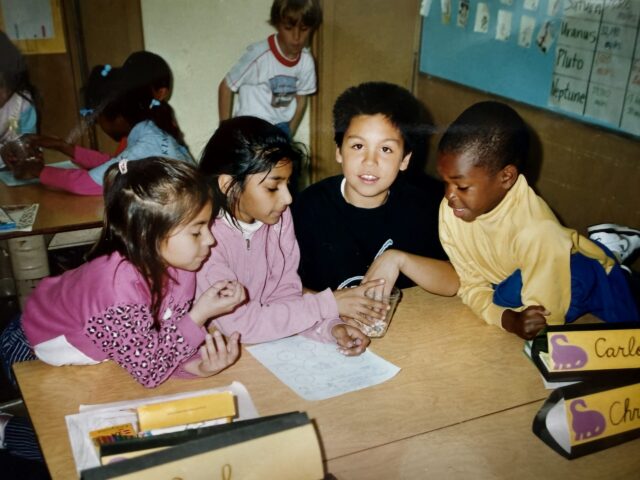
my first third-grade class
I was 25 when I became responsible for my first classroom of third graders. I’m sorry that Hanford didn’t believe she could have handled that at her age, but I’d spent a year in my credential studies plus another semester student-teaching and those experiences taught me what third-graders needed to know and how to teach them. (And I’d been in a cohort with dozens of student teachers who would have said the same.)
Some of my students did struggle with their reading, but I’d been trained in how to work with those students so they could participate in activities, nevertheless. And my small public school was supported by a team of three amazing reading specialists. They worked, individually, with my students who needed extra help, both inside my classroom and in their reading center. And contrary to what Sold a Story, Season 1 wants to convince you, though this was the early ’90s, a time when Whole Language methods were very much prevalent in classrooms, these reading specialists supported those students with a full toolbox, including phonics instruction.
* * *
More from Hanford:
The definition in America, I think for a long time, is that teachers design their own lessons and they deliver them… They’re taught that sort of the ideal is that you’re creative, and you create the activities and you come up with the stuff…
Yep, Emily Hanford, I loved to come up with the stuff. Creative possibility is what drew me to teaching in the first place. As an undergrad, I’d majored in psychology, thought I’d go to grad school to become a developmental psych researcher, but after working for a researcher on campus, I realized that the research process bored me batty. What electrified me were the findings.
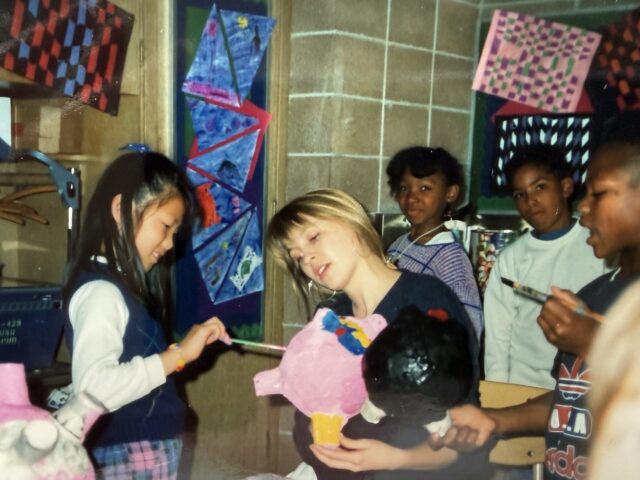
student-teaching, featuring a lesson I’d designed based on one from my own favorite, third-grade teacher
I’d never wanted to teach—though I’d worked with younger kids always, since I was a toddler big-sister myself—because it seemed like a job for girls with no ambition. But suddenly, the thought of taking research findings in education and applying them in a creative way, to make those findings engaging to kids? I was all in. And that’s how teaching played out for me. I loved designing lessons, loved innovation, constantly sought out professional development and, though Hanford seems to think this isn’t a skill that teachers possess, I kept up with the research. This wasn’t hard, since there were mentor teachers in my district keeping pace with research and sharing engaging ways to bring it to the classroom.
Teaching was demanding, but it lit my brain on fire.
* * *
That’s not all that Hanford has to say about teachers coming up with the stuff. Here’s the complete line, along with the part that’s been hitting teachers like a sucker punch:
They’re taught that sort of the ideal is that you’re creative, and you create the activities and you come up with the stuff, but direct instruction asks you to think, like, that’s actually not your job. Your job is not to design the lessons because in fact, that’s really hard and takes a lot of years of trial and error. Your job is to deliver the lessons and focus on the teaching and the students who are in front of you.
That’s actually not your job.
It’s hard to even know how to respond to this. What is the point of focusing on the students in front of you if your only response can be the next canned script you’ve been given? Teachers focus on the students in front of them to understand those students better, to grasp their strengths and challenges, so they can offer those very students what they next need to continue learning.
Hanford is making the case—the case that seems to be unfolding as the aim of season 2—that direct instruction, aka having teachers use pre-written curricular scripts, is the best way to teach kids to learn.
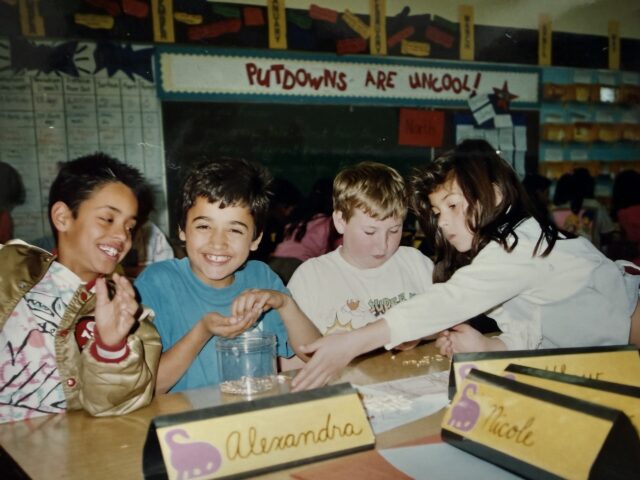
My third-graders, working cooperatively on a science lesson I’d designed
Want some insight into how students feel about this sort of instruction? This conversation about Sold a Story between teachers Trevor Aleo and Nick Covington alerted me to a recent open letter from over 2,000 students in Fort Worth, Texas to their superintendent and the state governor about their district’s recent shift to a scripted model, required to be used by all teachers. An excerpt from the students’ letter:
The teachers are just reading slides. They can’t choose what to teach us. We have, like, the same lesson every day. It’s just so uninspiring and honestly monotonous to go in and do the same thing every single day. A student said, “I walk in with dread, knowing today will be another day of reading from the exact same Google slide presentation.” We miss when we could listen to a teacher tell us about interesting things, things we cared about. When we could hear about the hidden meanings and power in words on a page. We haven’t felt that way in a long time now, ever since the slides came in. We want to feel inspired when we’re in class.
Geez, that letter guts me. How can students learn to think, if their teachers can’t model actual thought? And would these students have been able to write such a letter, a letter asserting their own agency, if they’d been educated from the start from scripted lessons?
* * *
More from Hanford’s unscripted chat:
“It’s also like a mass job. We need a lot of teachers. It’s not like we can select the most talented people or the people who are most into it. You know, we just need a lot of people to be good at this.”
What that says to me: let’s dumb down this profession so anyone can do it.
But education needs the most talented people, the people who are most into it. I believe it’s harder than ever to attract those people, that teacher vacancies are on the rise precisely because teaching has become so de-professionalized. Teaching has always been underpaid, but teachers today are doubted, disrespected, and told they don’t know how to teach.
I’ll tell you one thing: I would never, ever have become a teacher if the job required me to read from curricular scripts. And I imagine a legion of teachers beside me who would say the same.
Sold a Story, Season 1 may claim it doesn’t blame teachers for the issues it’s claiming to expose, yet the podcast’s distrust of teachers simmers beneath the storytelling, especially in the belittling way it characterizes teachers who followed leaders with whom Hanford does not agree. Repeatedly, the podcast snips from their social media, highlighting their excitement for what they were learning as if they’re gobsmacked tweens at a Taylor Swift concert.
I’m afraid Season 2 will only further undermine teacher professionalism. As Marcus Luther shared, curriculum companies are already rubbing together their hands.
In that pre-series interview, Hanford says that with this second series, her team is delving into “solutions journalism.” It’s not hard to guess at the solution she’s getting at when you hear how she sells direct instruction. “It’s not robotic at all,” she says, “when people get really into it.”
* * *
You might question my perspective, since I haven’t taught in a classroom in over three decades. (Though I continued my nearly lifelong quest to understand how kids learn best. Disclaimer below.1 ) Yet, I’d say this fact is what might make my perspective interesting. It allows me to remember, very clearly, that particular time.
In the early ’90s, teaching professionalism was at an all-time high. In California, at least, we teachers were trusted to follow state frameworks for different subjects, and were allowed to create lessons to satisfy framework requirements. I wasn’t teaching in a wealthy district, but there was ample funding for professional development. The pedagogy of the time favored lessons that engaged students with problem-solving and higher order thinking—like those writing workshops—and my third-grade students seemed eager to be in our classroom, to learn. They took standardized tests once a year, but my job performance was based on classroom observation from my principal and others, and not test scores. I felt respected and appreciated by the parents of my students.
In a conversation with teacher Adrian Neibauer, we chatted about how much, within the next ten years, all of that began to change.
If you follow my work now, you know I write about how much agency kids have lost in the past three decades, how I believe this is one of the greatest issues of our time. But the more I’ve delved into this work, the more I began to recognize another pattern: the people closest to those kids, the ones who might have aided against the onslaught—their parents and teachers—have had their own agency undermined.
The confidence and intuition of parents, mothers especially, began to erode with the internet’s rise and the unchecked melding of expertise and commerce. I dig into that here. And, during those same years, we’ve witnessed this weakening of teacher professionalism.
And sadly, this simultaneous erosion of agency has often pitted parents and teachers against each other, with both parties feeling anxious and powerless. I believe that Sold a Story’s narrative, its popularity, feeds into that.
If we really want to help kids—and we know today’s kids need help—we need to trust the people closest to those kids. Parents and teachers know best what kids need. Not administrators, or curriculum developers, or podcasters. We need to trust parents and teachers, empower them, help them work together to drive the systemic change that today’s kids are desperate for. Are writing open letters for.
* * *
If I were to design a lesson here—to come up with the stuff—about what storytelling can do, I’d have a listener tune in first to that unvarnished, unscripted Hanford interview. Listen and decide for yourself what she believes, the ideas that she wants to sell. Then listen to the second series. Note the storytelling techniques at play, how they work at your heart and mind. How, for one, Hanford opens the first episode with a charismatic character from education’s history—the irony of which some insightful educators have called out.
I’d like to think the kids I’ve worked with over the years in workshops, kids—now adults—who joined me in conversations about effective storytelling, would be able to name the techniques at play in Sold a Story. I’m damn sure they’d say they enjoyed those conversations, that our discussions helped them grasp the power in words those Fort Worth students long for, and that they’re glad I wasn’t reading from a script.
As always,
Patricia
cross-posted on Substack.
- Yes, I homeschooled with my kids. I was a former public-school teacher who saw homeschooling as a way to save on childcare costs, as a grand experiment in progressive education. My kids turned everything I thought I believed about learning on its head, taught me to value interest-led learning and independence. Yes, we had a vibrant community of friends. Yes, all three chose to attend high school. Yes, I believe that homeschooling expanded my kids’ worlds, rather than limiting them. No, I don’t believe that everyone should homeschool. I want public schools to thrive and wish we could bring more homeschool-style interest-led, individualized learning to the public school classroom.