For years I’ve struggled with the term unschooling. It’s such a great word, implying a complete departure from school. To me, it conveys a sense of kids leading their own educations, which is something we value around here. But it’s also come to imply, it seems, a certain lack of structure, and that’s the part that keeps me from embracing it. I’ve never felt that we could call ourselves unschoolers because we have a definite structure to our days. Or at least part of our days.
Structure. Now there’s another loaded word. Structure seems reinforced with negative connotations: rigidness, confinement, predictability.
I realize that I’ve written about this before. But it’s something that I think about often. And the more new homeschoolers I meet, the more I notice that many people still believe that there are two basic camps of homeschooling: unschooling and school-at-home. Sometimes new folks don’t realize that there’s a stunning variety of shades across that spectrum.
I know I’ve said this before too, but here’s a nutshell history: when we started homeschooling, we were fairly schoolish. It had only been a few years since I’d been a classroom teacher myself, and that was what I knew. Granted, I was a pretty creative teacher, and I had lots of neat projects in mind! But my oldest child quickly cured me of all My Good Ideas. “I don’t want to do that art project,” he’d say, or “I don’t want to read that book.” He asked questions like, “Why should I write down my thinking on that math problem when I can just tell you? You’re sitting right next to me!”
Good points. He was right. When I let him do projects that interested him, he was immersed. When I forced him to do work he didn’t want to do, he was angry and frustrated and didn’t learn much. I learned to stop doing that. (Well, I slowly learned to stop doing that. Sometimes I’m still learning.)
I got better and better at dropping the schoolish thinking that had me teaching him, and planning lessons for him. But we kept the habit of working together for a few hours most mornings. We had fun reading together, making things together. Knowing we had a few open hours meant we could take on big projects, make big messes. Plus, it was the one time of day that the kids knew they had my full attention, that I wasn’t going to get lost on the computer, or start talking on the phone. Still, the fact that we did it every day, at a particular time, made it a structured activity. With all those negative connotations.
I finally came to terms with our homeschooling style a few years back when I read The Creative Habit, by choreographer Twyla Tharp. I read the book for help with my writing practice; only later did I realize its implications in our homeschooling life.
Tharp writes:
“There’s a paradox in the notion that creativity should be a habit. We think of creativity as a way of keeping everything fresh and new, while habit implies routine and repetition. That paradox intrigues me because it occupies the place where creativity and skill rub up against each other.”
And:
“I will keep stressing the point about creativity being augmented by routine and habit. Get used to it. In these pages a philosophical tug of war will periodically rear its head. It is the perennial debate, born in the Romantic era, between the beliefs that all creative acts are born of (a) some transcendent, inexplicable Dionysian act of inspiration, a kiss from God on your brow that allows you to give the world The Magic Flute, or (b) hard work.
If it isn’t obvious already, I come down on the side of hard work. That’s why this book is called The Creative Habit. Creativity is a habit, and the best creativity is a result of good work habits. That’s it in a nutshell.”
Reading her book convinced me of what I’d already sensed: that scheduled practice doesn’t have to undermine creativity; rather, it can help it to thrive. I could see this with my writing. I don’t have the freedom at this point in my life to write whenever the muse strikes; instead I have to plan time for it. And I’ve done it for long enough now that my creative mind is conditioned to get right into the work, pretty quickly after I sit at my desk. I only have so much time, and I don’t want to waste it.
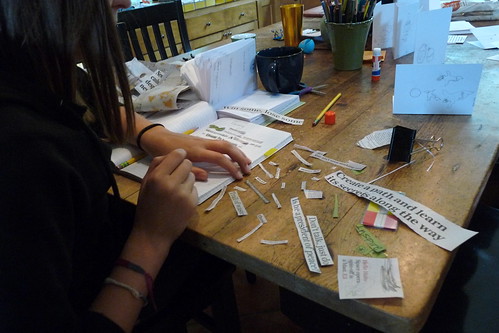
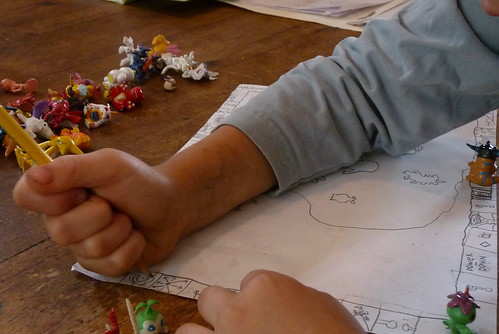
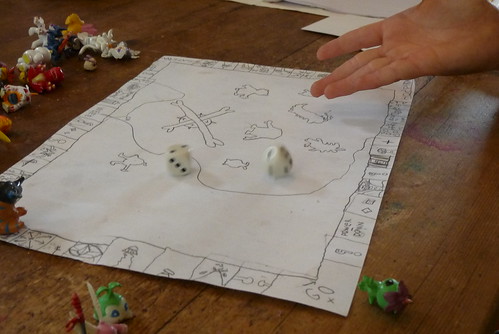
I think it’s the same for my kids. Gathering in the kitchen at 9:30 or 10:00 each morning for tea and a snack is their cue to start thinking, start bouncing ideas from their heads to the ceiling to the yellow counters and back again. I’ll often throw out a few suggestions, depending on what they’re working on, but more often than not, they have their own ideas. Today Lulu wanted some ideas for writing and I pulled out our copy of the utterly fabulous Don’t Forget to Writefor her. Something there gave her the idea to make found phrases poems from the newspaper. Mr. T wanted to do more work on the game he’s designing. Would they have done these activities later in the day, on their own? Maybe. They do lots of interesting projects on their own, in the morning, in the afternoon, throughout the day. But this morning, Mr. T needed my help to write his game rules, and Lulu wanted help brainstorming a project. And I was there to help them. Then they were on their way.
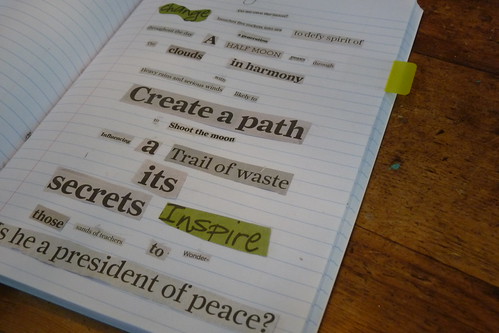
Sometimes I call what we do structured unschooling because the phrase is so laughably oxymoronic. But I think I’ll just strike the word structure from my vocabulary and use habit instead. A homeschooling habit. That’s what we have most mornings around here–complete with tea and snacks.
perfect! i couldn’t agree more. love the phrase “homeschooling habit”. and your habit reminds me of an interview i heard on npr with michael chabon (practically a neighbor of yours!): http://www.npr.org/templates/story/story.php?storyId=113719470
he certainly believes that writing is hard work and a habit. he sits down and writes 1000 words every day, whether it’s good or drivel. i like that idea. and i LOVE L’s found poem. i showed avery the picture and she ran to find magazines to cut up 🙂 reminds me of the words i cut out of magazines and laminated a few years ago. i should get those down and play poetry.
Thanks so much for the link, Molly. I just listened. I love hearing writers speak on their craft. I’ve read scattered works of Michael Chabon–not much of his most recent stuff–but I’ve liked what I’ve read. Now I’m thinking of ditching my plans to read Virginia Woolf in November and reading his new book of essays instead…
I especially appreciated his comment on how he belabors every sentence in everything he writes, even emails. I thought it was just me. Oh, to be able to dash off words quickly!
Found poetry is fun. Sometime I’ll write here about Susan Goldsmith Wooldridge’s word tickets activity. (From the excellent book Poemcrazy.) It’s a form of found poetry, and one I’ve used often with groups. People of all ages never fail to love it.
Hi Tricia,
I don’t think people realize that “there’s a stunning variety of shades across”… the “spectrum” (I’m borrowing some of your words) of the definition of the word, unschooling.
As you and I have discussed before, I think structured learning may be child-led. Child-led are the key words I identify with unschooling. The fact that they decide what they want to learn, to me, is the essence of unschooling.
The practice of meeting at a certain time each day makes no difference in my mind. Your kids are willing to meet then. This is their routine–no different than a bowel movement (excuse my lewdness) at the same time each morning; it’s part of your family life and togetherness.
Kudos to your flexibility in meeting their needs and interests.
Well, Kristin, I’ve made many analogies for homeschooling over the years, but never once have I compared our learning style to bowel movements! I can always count on you to put a unique spin on things!
(Just think of the interesting blog searches that might come my way now…I’m forwarding them all to you.)
Regardless of our individual “spins”, I know you and I have pretty similar approaches to working with our kids and understanding how they learn best.
This exchange literally made me laugh out loud (or maybe cackle) and I therefore had to tell you so in spite of my aversion to the tired net shorthand for this phrase that always has me thinking of a tongue lolling out of a mouth, along with bulging eyes or something. (There, in the spirit of your earlier post, A Post Without an Image, I’ve now expanded my thought from three letters to over 40 words, if you count parenthetical interjections). Thanks for the needed laugh!
Anyway, I originally was going to comment and say how inspired I am once again by your thoughts on homeschooling–I, too, love the idea of unschooling, but not the implied lack of structure or facilitation. I am somewhat interested in the concept espoused by Oliver DeMille in his books and website of what he calls a Thomas Jefferson Education–basically letting kids be kids while they’re young, and inspiring them to go to source material (the classics, so to speak) when they are older and interested in reading about a subject.
Well, I’m glad you got a good laugh, Barrie! I did too. And thanks for the more than 40 words. I feel pretty lucky to have commenters who leave such thoughtful comments–I think it’s somewhat rare in Blogland. (And you’ve probably figured out that I am a fan of the parenthetical interjection.)
I’ve only heard of Oliver DeMille’s work in passing, but I think the notion of kids going to the classics–and more formal learning–when they’re older makes sense. At least it has for my older two. They just naturally begin to learn differently as they grow up. But for us, having the habit of doing something most mornings has facilitated that learning, I think. And on the flipside, I think having regular experiences of playful, creative learning when they’re young has helped them realize that that sort of learning is valuable too. As they’ve gotten older, sometimes they’ve chosen the more formal route, sometimes the more creative, fun one. I’m glad they know that both have their benefits.
I remember reading somewhere that the job of unschooling parents is not to bring content and curriculum, but to bring energy and attention. When I bring focus and attention to my kids, it helps them bring focus and attention to what they are doing. I’ve gotten greedier with our time at home, and am scheduling us for less out of the house, so we have more predictable stretches of uninterrupted time to learn and explore together.
The whole “are you a real unschooler” conversation sometimes just brings me to my knees. Seriously. I recently read a thread on a discussion board entitled, “Does unschooling always mean unlimted TV and sweets?” Or another discussion in which a parent suggested that picking out books for your kids at the library was coercive, because the kids would know that you wanted to read them, and therefore feel pressured to do what you wanted. Really? I’m no extreme radical unschooler, but I certainly lean more towards unschooling than anything remotely resembling school-at-home. To me, the cornerstone is that I work in partnership with my kids, am responsive to their needs/interests/learning styles/etc., and am available to facilitate–and yes, even sometimes guide–their learning adventures.
I am on my knees with you, Barbara. All the nitpicking about what unschooling is and isn’t seems to alienate more than build community, so I mostly just stay out of it–and don’t call us unschoolers. Even though I think we have lots in common with many unschoolers.
I appreciate what you say about the job of unschooling parents, and I can absolutely relate to your greed about time at home. Staying at home most mornings is something I’ve guarded from early on, and it’s often hard to explain to others. It makes us sound very structured and uptight, while my reasons for insisting on it are quite opposite. I want to have, as you say, “more predictable stretches of uninterrupted time to learn and explore together.”
I read a wise quote the other day, about the importance of being present for our kids. Which is one of my main reasons for having our morning habit–I’m there for the kids as much as they’re there for me. Check out the quote, the one posted by Barbara:
http://www.homeschoolstylebytes.com/discuss/post/906799
Oh, wait, that was your quote! 😉 I loved it.
I too struggle with the term unschooling: makes total sense to me as an educational philosophy, but like Barbara, I find myself quite uncomfortable with some of the conversations about what does and doesn’t constitute a “true unschooler.”
As a homeschooling newbie, I decided to reevaluate and tweak periodically to see what feels right and what doesn’t. I’ve been thinking a little more structure (I’m trying to think of it as “support”, not so much as “scheduling”) to our days might feel good, and you’ve given me some things to think about.
My sister gifted me The Creative Habbit a few years ago, and I loved it. I just recently pulled it back out “for me”, but now want to go reread some of it with an eye towards our new homeschooling venture. Thanks!
The best homeschooling philosophy for us seems to be “tweak as you go”. I’m glad you figured that out so early on!
I think there’s a lot to be learned from comparing learning as a homeschooler to the practice of an artist. At least if creativity is something you value.
This discussion reminds me of a blog post that I have bookmarked in my inspiration folder:
http://www.justenoughblog.com/?p=448
I find that the line between home-educating and parenting is frequently blurred in many unschooling circles. I got hung up on this for awhile (can we really attempt unschooling if I enforce bedtimes and forbid ice cream for breakfast?) but then realized that whether we subscribe to a label or not, we are free to define homeschooling (or unschooling or RU) however we want…and change it if need be. Because really, who’s keeping track???
I do think we could benefit from adopting your tea and snack habit into our learning day 😉
I saw Tammy Takahashi at our homeschooling conference this summer. She seemed very down-to-earth and reassuring, just as she seems on her blog. Thanks for linking to her post.
And yep, we can and should define our homeschooling however we want: isn’t that the point of it? Hooray for you for figuring that out.
Patricia,
I loved this post, too. It really helped express a lot of what I’ve been thinking about these days in our homeschooling. It also reminded me of another blog post from the same blog Melissa S. referenced.
http://www.justenoughblog.com/?p=1631
Ooh, that was a good link too. I hadn’t read it. It’s nice to hear others questioning the whole unschooling-and-where-do-I-fit-in-it conundrum. Thanks for sharing it.
Just stumbled onto your blog through a link I found on another blog and I loved this post! We’re just beginning with homeschooling and your post so beautifully put into words the inner conflicts and ideas I’ve been working through as we find our way. THanks for that! I’m going to link to it on my blog!
Hi Susan! It’s always nice to be stumbled upon!
I’m honored that you linked me on your blog. I read down to your post about your son having trouble holding his pencil correctly. Know that you’re not alone. Check out my almost-eight-year-old’s pencil grip:
http://www.flickr.com/photos/9357042@N03/3403806315/
He has no plans to change. Yet he manages to draw amazingly intricate drawings and has nice handwriting. Maybe he’ll switch at some point. Then again, I wouldn’t be surprised if he became a professional artist–with a truly quirky pencil grip.
Lovely post. I think you have found a wonderful way to homeschool and the name doesn’t matter. I am inspired again to make our mornings free (that was the plan for this fall) and myself available. I’ve succeeded with the former, but not always with the latter.
Thanks, Susan. But don’t think about such things right now. You’re in Hawaii!
Thanks so much for this…I have been waging an inner battle with myself over this issue and it just keeps swirling and swirling around. I often wonder why my previously public schooled daughter (almost 13) goes blank when I ask what do you want to learn about? I get panicky, think Charter School and feel like I’ve falied her. But, what I am realizing after reading your post and the great comments (I am on my way next to read the posted articles) is that if I don’t facilitate the time for learning, exploring…..make it a habit…it’s asking way to much of her to come up with nothin’ with nothin’. Ahh, breakthrough!! I have always worked so hard to protect one day a week…this year it’s Monday but I never thought of a part of every day. Thank you again and I am taking you out of my favorites and linking you….so I don’t miss anymore good stuff 🙂
Thankful,
Dawn 🙂
Dawn, I’m so glad that the post was helpful! And the comments too–aren’t they fantastic?
My kids do much better having a short amount of time regularly to work on projects. In the past, when we’ve had too many mornings out, they don’t have enough continuity, and they lose their original excitement.
I’ve heard that kids who go from school to homeschooling often make a slow transfer. They’re not used to being able to come up with their own projects. Sometimes what works for us is that I notice something they’re interested in, and then we brainstorm together what they might do with that interest. Right now, my 7-year-old is learning about Wolverine, of the X-Men…whatever they’re excited about works for me!
Thankyou so much for this post. I believe that many who are new to homeschooling need to read experiences like yours. I have recently spoken to friends talking about unschooling and feeling panic because they thrive on some structure. They need to hear that structure isn’t the death of creative learning.
Thanks for visiting, Mon, and for linking me on your blog too!
It took me years to figure out that, for us, structure doesn’t have to undermine creativity. If a few folks can learn from our experiences and work that out faster, I’d be thrilled.
HI there,
I just wanted to say how much I enjoyed this post. We are unschoolerish folks finding our way in this journey, but I have been feeling a bit adrift without some sort of structure in our days, as if so many days just fly by without me spending any real time with the littles, without anyone really ENGAGING in more than just flitting from thing to thing while i struggle to cook and clean and do basic childcare.
I LOVE the idea of setting aside time to be together in focused creativity, regardless of what goes on in those moments, of having the kids know that they get me, no holds barred, no distractions during that time.
You have made our lives richer (and I think possibly less overwhelming with this simple post.
ANno
Hi Anno! Thanks for taking the time to leave a comment.
I’m glad the post has been helpful. I know just what you mean about days flying by without feeling like you’ve engaged in much together. That’s exactly why planning time together seems to work for us. And I’m glad you get what I mean–that it isn’t so much what we’re doing together as the fact that we’re doing something. And making time for each other.
Wishing you some fun times together!
Great post, which I’ve just found! I don’t know the origin of the notion that unschooling=unstructured. Perhaps it’s because the word “unschooling” is such a difficult one to fathom, and that it seems the opposite of school. I have a big problem with defining oneself by what one isn’t, so I prefer the term “life learning,” which I hope is more accurate. But even then, it doesn’t begin to describe the breadth and depth of self-directed learning. For me, the foundation of it is learner autonomy. But, aside from needing a shorthand term with which to discuss this way of life, I don’t think it matters much what we call it. There are no rules! There are no unschooling police who decide whether certain habits or structures or other practices do or don’t fit the definition.
Wendy, I’m honored that you’ve poked around my blog and taken the time to leave a comment!
It’s funny how worked up people can get about semantics, isn’t it? I also value self-directed learning over all else. It would be nice to have a label that people would understand–but I suppose labels tend to be limiting. What matters most to me is that people understand that the ways to homeschool are infinite, and that we don’t let labels confine us.
I just noticed via a link that you’ve listed me on the Life Learning Blog Directory. Thank you!
Thanks so much for sharing this with me.
It’s funny because we never started out to be unschoolers. We just believed that people learn and are passionate and felt that if we could give our kids the opportunity to stay out of institutionalized learning it would be a huge gift for them. It’s what we both wanted for our family.
Then came all the labels and to tell you the truth we don’t like “unschooling”–the word at all. We’re not un schooling; we are living. But when you’re navigating communities you don’t always want to explain everything and we sort of like to hang out there, although I find–just like you do–that we love some structure and rhythm and when we’re around radical unschoolers it doesn’t feel like the best match.
I guess we’re just…..us 😉
Thanks again for the great insights.
Hi Hillary,
This line of yours says so much:
“I guess we’re just…..us”
So simple, and so beautiful too. What could be better than helping our kids find who they are, and our families figure out who we are?
It seems silly to move away from one institution–school–only to let a term like unschooling confine us in different ways.
I also loved this line of yours from your Simple Homeschool post http://simplehomeschool.net/interest-driven-curricula-and-an-open-mind/ “If there is anything I’ve learned in life and parenting it’s to keep an open mind and heart. You never know what might be around corner, how life will unfold or how someone’s needs may change.”
Good for you for recognizing this while your kids are so young! I’m sure that thinking will serve your family well in your homeschooling life.
Thanks so much for stopping by!
Great post, great new design by the way. I am loving exploring (is that correct grammar?!?) your blog all over again, with its new layout. It’s like a clean, well lighted place. So tempted to homeschool after reading what you say here. Thank you for the excellent ideas on setting up the environment.
Thanks for the kind words about the new design, Lisa! I spent a good amount of time on it, so your feedback means a lot to me.
So you’re not homeschooling, but you’re tempted, eh? Keep playing with the idea. It’s full of potential!
You left a comment on Penelope Trunk’s blog that had me opening tab after tab: “visualization designer”; “visualization of the Iliad”–which I read to them this winter for our Ancient Greek unit; “The Creative Habit”; “The Age of Mythology Game”; “Don’t Forget to Write”.
Your blog about a year of essayists fascinates me (BA in English, dodged a Masters just before signing over my entire savings for it), as does your experience being a schoolteacher and gradually evolving into a life-lead learner.
You seem the right balance of discipline and passion (one needs a habit to be creative). I sometimes feel bi-polar in my taskmaster-meets-whimsy approach, and reading of someone who has found a way to temper the two–and with grown kids to show for it–has me excited and relieved. I’ll be subscribing…
Hi Jennifer. Welcome!
Anyone who takes an interest in my essayist project gets instant cred with me. 🙂 It was a quirky little project, and definitely not one to get a lot of traffic or comments. But it’s still one of my favorite things to have done on this blog.
I hope you’ve scrolled through the comments and realize that there are plenty of us who struggle with the taskmaster-meets-whimsy approach! There will always be a bit of a struggle in figuring out what our kids need, I think, because it changes from day to day and year to year. It’s worked better for me to stop looking for a label and a fixed philosophy, and just keep a habit of gathering together and asking, “What do you want to do?”
Thank you for subscribing. Always makes my day.
Hi Patricia,
I came on over to check out your blog because two friends (Molly who left the first comment on this post and Annie who creates the wonderful Alphabet Glue) mentioned you in conversations this week.
What inspiration I am finding here! This post is just what I needed right now. We have swung from an unschoolish-child-led-project-based-learning mode to “lessons” this year and we are having a hard time finding a balance. We do function better with “structure” in terms of keeping us all sane together, but I really like the idea of that structure being a habit of coming together rather than ridged lessons. Your approach makes a whole lot of sense. Thank you for sharing your insights. I look forward to spending more time here!
Hi Dawn! I just spent all day yesterday driving to a training with Molly, and she was telling me how much she’s enjoyed your phone calls. Thanks so much for dropping by! I look forward to getting to know you better–Molly says good things!
oooohhh, I LOVE YOUR POST! I’m going to stick around and read some more! We sound so similar, actually. We are very unschool-y in our ways and I also love Charlotte Mason who turned me on to habit training. I have a whole category on my blog. I’m not a CM purist but I love her principles. I also tried, for a long time, to find a way to describe us. US-schoolers, Relaxed Charlotte Mason, Eclectic but Unschooling doesn’t quite fit with what most people think as unschooling. YET, it is what we are doing, just like you all. LOL My son did the same things too! He didn’t like my prepared lessons, he prefers to talk about math instead of write it down, etc. I just subscribed to your blog.
Hi Cori! Thank you for the kind thoughts, and for subscribing! I’m glad you felt a kinship here: the names of our blogs tell us that we have something in common! Very nice to meet you.
Thank you thank you thank you! I needed encouragement today. YOur ideas about the writing process rally helped me to realise I need to ease up on my son. So much of what i thought would get done today didn’t as I was faced with many more interruptions to homeschooling. Then my 10 yo son wouldn’t get off his computer to do boring work with me, so again we were in a conflict! Finally all he wanted was some “tickle” time. How blindsided was I??? As an extreme premee I forget that only recently has he become comfortable with that kind of affection, so I need to backtrack and just have fun with him. We DID manage to read together, and he labored over 3 math problems, so I should be thankful. I wish I wasn’t so stubborn and old schoolish!!
Homeschooling is hard sometimes, isn’t it, Polly? Over time I got better at reading my kids’ cues. If they’re excited about something, they’re learning. If they’re bored, they aren’t learning much, so we look for a different approach. My kids have been very good at helping me break out of school-thinking, which is almost never useful.
Glad that you recognized the importance of tickle time! Kids can be so smart about knowing what they need.
Where have you been all my life?! What a great post and so perfectly put. I have always envisioned unschooling to be about choice. And with that choice comes a freedom to put into motion those things you are passionate about. Or perhaps simply the act of searching for one’s passion. Without a method, that searching is rather aimless I find. Thank you. I’m looking forward to roaming around your site!
Ha, Stacey, I’ve been right here for four years now! What took you so long to find me? 🙂
Glad you found something here you could relate to. Please roam!
I am a bit all over the place at the moment, and now (after revisiting this post,) I’m thinking, well, yeah, we don’t need to either be radical unschoolers or not be, do we? We just get to make it up for ourselves, every day. Every time there’s a tweak, we can reinvent our home education, and we don’t need to figure out whether that means we fit into one label or another or none of them. And if there’s a facebook group that doesn’t want us because of it, well, phooey to them.
I love the idea of time at home, and of a structured morning, or whatever. A habit. I’m such a homebody. Man, though, they’re 2 and 4, and days where we don’t get out the house tend to leave me feeling like someone’s going to end up in a box.
We’ll figure it out. All in good time. And over and over again, no doubt. And I’m very thankful for all the pointers!
“We just get to make it up for ourselves, every day. Every time there’s a tweak, we can reinvent our home education, and we don’t need to figure out whether that means we fit into one label or another or none of them.”
That’s the way to think about it, wandering sue! One of the biggest reasons for home education is that you can do it the way you want to–and the best way to do that is to make it up for yourselves, every day. I suppose it can be comforting to subscribe to a label that tells you how to do things, but it can be much more freeing to simply try a variety of approaches and see what works best for you and your family. And that will change constantly as each person grows and changes.
One reason to consider setting some habits in place is that it’s much easier to release habits than to try to start them up in a life that has been more unstructured. The younger kids are when you establish habits, the easier it is to keep going–even if you tweak those habits along the way, as you should!
And if you need some time out of the house, then make that a habit too! xo.
Working on setting up those habits. Tricky, but feeling good!
Going out every morning is currently very important, because if we leave it til afternoon Lauren (2 1/2) inevitably falls asleep and wakes up back at home, and furious about missing wherever it was we went. But then we’re all a bit tired in the afternoons. Henners is just 5, and really doesn’t seem to want much of my help at the moment, except to keep Lauren out of his Lego. We’re having lovely, relaxed, fun days, just what I hoped this would be about, at this age. But I’m aware that he’s not interested in anything that happens while sitting at the table, so trying to find other little routines. As you say, because it’ll be harder to start, the longer we leave it.
I love that you tempt them in with a snack.
Still thinking…
It’s all about figuring out what works for your family, Sue! I think some people give up on the idea of a formal “learning together” time because they try to apply someone else’s model and it doesn’t work for them.
Table-learning for most five-year-old boys is probably not ideal; Henners is showing you what he needs! Maybe he’d prefer listening to you read while he builds Legos (although then you have that Lego-loving sister to worry about!) Maybe he’d like to listen to simple audiobooks on his own while he builds. Some of his most important learning of the day might be the conversations while you’re out and about. Maybe he and Lauren would like scrawling on big pieces of newspaper on the floor, rather than while sitting at a table…
Try to get the classroom model of learning out of your head and watch your kids and see what engages them. Do more of that.
“We’re having lovely, relaxed, fun days, just what I hoped this would be about, at this age.” Sounds about perfect to me!
I just wanted to say, “thank you” for this post. I know it is from several years ago, but a friend just sent me the link this morning. Our children are publicly schooled for a couple of reasons; 1. I am unsure of MY ability to give them all they need education-wise, and 2. my husband is not really in favor of us homeschooling because of cost (for curriculum & such) and because of HIS doubt of our ability to give them what they need to be able to continue their education if they chose to. Now, having said that, I do not feel that they are learning all the necessary skills in public school, so I have decided to do what I was calling “mock” homeschooling. I want to help my daughter improve her penmanship skills (the school doesn’t teach cursive anymore, so I taught her here at home during her 3rd grade year…she will be in 5th grade next school year), but I don’t want to give her droning pages of “trace this, now write it yourself” worksheets. Instead we have found 3 out of state friends with daughters who would like pen pals. My 15 yr old son loves music, so there will be plenty of that and I will be trying to teach him to check & change oil in the car/truck, how to change a tire, and how to plan and cook meals. It is good to know that I am not the only crazy one who wants to UNschool, but to do it in a structured way lol.
Thanks so much for taking the time to share this, Fantacy. The best thing about homeschooling, to me, is that you get to do it however you want, in whatever ways work for your family–even if the plan includes school. Homeschooling is a way of thinking, more than anything. It’s an essential belief that your child’s education belongs to your child and your family, and you get to shape it together. The fact that you are watching your kids, and searching for ways of learning that will intrigue them makes you a homeschooler, I would say! Enjoy the process!
I couldn’t agree more! For the 17 years I’ve been teaching my own kids, I have struggled with the gray area between structured and free. It’s the thing that trips me up, every year!
I realize that routine is better than schedules, except that routines tend to drag on and sometimes don’t produce the results, like schedules tend to do.
However, I always fall back on not wanting to waste our freedom. Afterall, it’s one of the reasons we teach our own children – one of many.
I love the term “habit” and I’ll be reading Twyla’s book, for sure.
High five to a fellow 17-years-homeschooler!
I know what you mean by getting tripped up by the balance between structure and freedom. Yep!
Nice to meet you, Debbie!
Another good one — thanks. I love the idea of a Homeschool Habit. I think that is a great fit for us too.
Yes, I like it too. Our homeschool habit has fallen a bit by the wayside this summer, and I think my 13-year-old and I both miss it.