poet of my heart
Dear fellow wonderer,
Since October, I’ve been hosting a monthly reading series for caregivers at a new-ish and lovely community space here in Oakland, Local Economy. The experience has been–pardon the un-poetic hyperbole–magical. Brilliant writers plus caregivers of all ages, a circle that welcomes conversations, and babies in the center, warming our hearts and opening them so we go deep together, fast. (If you’re local, please join us!)
Our April gathering was our first foray into poetry. We were joined by Rachel Richardson, who read from her moving collection, Smother. We talked about motherhood, climate change anxiety, the value of mother-friends and the grief when those friends are lost. We went deep together, fast.
It was a small group, the smallest of the series so far. I asked Rachel about this, suspecting the cause was poetry itself. Our culture doesn’t seem to value poetry, I said, and Rachel chuckled, knowingly.
This gets me wondering.
* * *
Back in the early nineties when I was a teacher, every third-grade classroom in my district had a full set–a book for every student–of Mary O’Neill’s Hailstones and Halibut Bones. Do you remember this book? Originally published in 1961, it’s a collection of poems about colors. I remember myself in third grade, my teacher reading aloud from the book, us making tissue paper art with water-thinned Elmer’s glue, based on the color poem of our choosing.
After my students and I read the book, they wrote their own color poems.
It wasn’t the only poetry we read and wrote in my classroom. We read Let’s Marry Said the Cherry and students wrote their own rhyming nonsense poems with accompanying cartoon art. When we studied the solar system, they wrote poetry about the planets. Poetry is an excellent format for seven and eight-year-olds. It’s concise and often playful. It tickles the ear and wakes up the mind and young kids, who think and speak like poets, tend to write it with ease.
I know you’ve heard me rail on about how much classrooms changed with the passing of The No Child Left Behind Act of 2001. How “a rational, results-oriented and business-minded approach to public education” became the new norm, undermining everything from child-centered learning models to recess; from lunchtime to science and the arts. I chatted about this at length with teacher Adrian Niebauer.
Here’s a story to help you grasp my point. A few years back, volunteering with Chapter 510, an incredible local youth writing center, a team of us visited an elementary school one morning, helped them compose a school-wide epic poem. I was placed in a second-grade classroom.
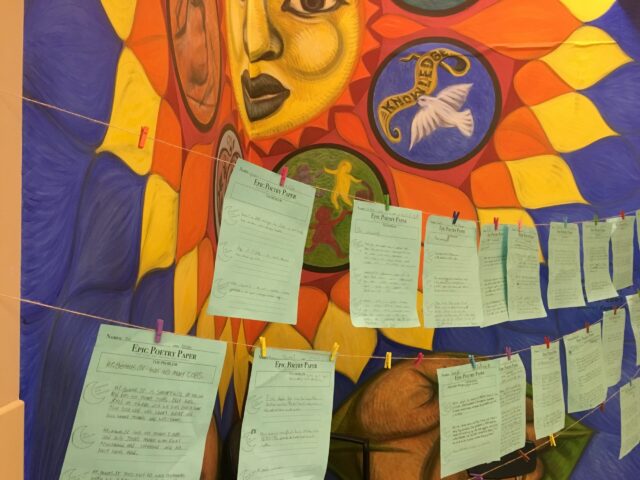
epic poetry
At the end of the morning, the classroom teacher said to me, “It’s so good to see my students write poetry!”
I was confused. This was a second-grade classroom. Second-graders, bursting with creativity and underdeveloped prefrontal cortexes that free them from worrying what others think, are the world’s most natural poets. I asked, “Don’t they get to write poetry?”
The teacher shook her head, sadly. “It’s not in the curriculum.”
* * *
Rachel’s collection grabbed me immediately, beginning with her epigraph in which she quotes J.D. McClatchy, editor of The Yale Review:
I automatically reject any poem with the word “mother” in it.
Ooh, already I knew I was in good hands. (And yes, our circle had fun clawing at that epigraph during the reading!) I sucked down every poem of Rachel’s with the word “mother” in it, relishing their specificity, their complexity, how they admit to yelling at kids, one-upping them. They reminded me how poetry forces my brain to work differently than does other writing. The work is a little harder, less linear, engaging my mind, snagging on thoughts and memories, shaking my brain awake. Looking up, I see the world from a slightly stranged angle.
One of my favorite poems in this collection is “The ‘I Want’ Song,” in which Rachel names the moment in every Disney movie when the main character gets to “howl her ‘I Want’ song straight into our chests.” You can hear the poet Major Jackson read the poem and share thoughts about it on The Slowdown. (And interestingly, Jackson’s thoughts weave right in with what I’m tussling out in this letter.)
From “The ‘I Want’ Song”:
But there’s so much that I want–
for the trees not to burn, or at least
not these trees, not unless they’re far away or
beneficial to the understory. I want to stop
feeling like I’d better buy the fruit
now because maybe next year there will be
no more fruit, no more water, maybe the crops will burn
or wither or be sprayed with the chemical that kills
the bees and which studies now show
kills the bees’ children and children’s children
two bee-generations after exposure.
I want not to think about the expiration of the world.
* * *
I want not to think about the expiration of poetry. Why isn’t it in the curriculum in my district’s public schools? I suspect poetry is now viewed much like play: a frivolity that isn’t necessary, that won’t help students achieve on tests, get them into ranked colleges, lead to high-paying jobs.
You know I disagree. You know where I stand on play.
* * *
My kids grew up on poetry. Mother Goose, Jack Prelutsky, A. A. Milne’s Now We Are Six when they turned six. But now I am Six, I’m as clever as clever. So I think I’ll be six now for ever and ever.
My oldest especially loved Shel Silverstein. Captain Hook must remember, not to pick his nose.
My youngest, still a great fan of the absurd at 24, adored the absurdity of Karla Kuskin. The dragon smiles because he knows
that nothing tastes as good as toes.
But my daughter has always been the poetry afficionado, starting at two with Shirley Hughes’ Rhymes for Annie Rose and blossoming from there. She wrote poetry constantly, narrating a poem about the moon at four–Oh Moon, tonight you are a crescent. A horn, a headband, an angel’s halo. A croissant I’d like to eat. About ballet at eight:
A dancer’s dream is to be on stage,
to dance on stage,
to shine on stage.
A dancer’s dream is to dance for joy,
across the big, bright stage.
For most of her childhood, I facilitated writer’s workshops for the kids and their friends, but when L turned twelve, we tried something special, a year-long poetry workshop for just five girls. Around our kitchen table there was tea, and the anthology Seeing the Blue Between, from which we read poetry and learned from poets. And then we wrote poetry–me included. A sacred sort of gathering that makes me think of the reading series with babies, now.
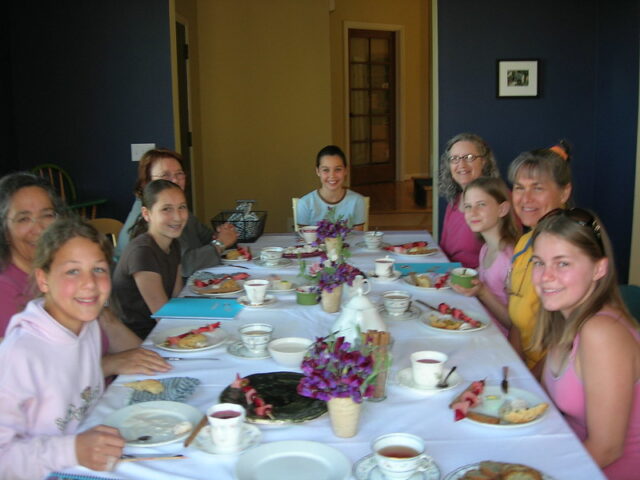
Final reading, somewhat blurry, with tea and mothers
Years ago, as a homeschooling parent (see disclaimer!1) I wrote a post for fellow parents on helping kids love writing that went small-time viral in that long-ago blogging era. It contained this:
In other words, don’t worry if your child wants to write nothing but poetry for two years. That’s pretty much what my daughter did at eleven and twelve, and she eventually moved into other types of writing. Meanwhile, she learned what all poets know: every word matters.
True. L has always understood the power of words. As a high school debater. In her ballsy college application essay. In her career now as an urban planner engaged in community development, work that depends on written and spoken communication. Skills she scaffolded on the butterfly wings of poetry.
* * *
But I want to argue with myself here too: I don’t think we should include poetry in a curriculum simply because it has something to teach.
Poetry helps us feel, know ourselves. Most kids come to understand this, even if they don’t get poetry in the classroom, by falling hard for some form of music. Poetry set to a beat. As teenagers, we learn lyrics because lyrics help us figure out who we are.
My husband still talks about a high school English assignment. Each student picked and presented a favorite song, played it on cassette for the class. They printed and passed out the lyrics for all and analyzed them–as poetry.
He shared Bruce Springsteen’s “The River,” a pretty dark story of teenage life to share in an early eighties classroom. The young teacher2 welcomed all of it, including his friend Bob’s punk pick–was it Flipper? This was Chris’ favorite high school assignment, “The only one I remember,” he says. A profound exploration, a sharing of self.
I’d like more of that in today’s “curriculum.”
* * *
And I suppose that’s why I’m sad we didn’t get a bigger crowd for the series’ first delve into poetry. We’ve had bigger crowds for novels and memoirs. But the largest crowds, by far, have been for nonfiction books on a particular topic: on care, on parenting boys, on mom rage. These are fantastic books, don’t get me wrong: non-prescriptive, thoughtful plunges into complex topics, in which supersmart authors probe essential questions.
And yet, when it comes to parents, mothers especially, I’m concerned, as you know, about constant information intake. How it may be making it harder than ever to hear our intuition.
What to do? Maybe take a break from experts and influencers and so much information. Maybe read a poem. May I suggest “The ‘I Want’ Song”? Have Major Jackson read it for you. Or maybe, if you’re really lucky, hear Rachel Richardson read it aloud, circled up one morning around babies on blankets, teething and teetering and wandering off. And maybe later, find a little time, somewhere, somehow, to compose a list of what you want.
I think that list might tell you something. Something about what poetry can do. Something about yourself and what you need–really need.
As always,
Patricia
cross-posted on Substack
- Yes, I homeschooled with my kids. I was a former public-school teacher who saw homeschooling as a way to save on childcare costs, as a grand experiment in progressive education. My kids turned everything I thought I believed about learning on its head, taught me to value interest-led learning and independence. Yes, we had a vibrant community of friends. Yes, all three chose to attend high school. Yes, I believe that homeschooling expanded my kids’ worlds, rather than limiting them. No, I don’t believe that everyone should homeschool. I want public schools to thrive and wish we could bring more homeschool-style interest-led, individualized learning to the public school classroom.
- Though I went to the same high school, I was bummed not to have this English teacher. But a few years later, as a young teacher myself, fate would finally let me learn from Rebekah Caplan when I attended the Summer Institute of the Bay Area Writing Project at UC Berkeley. That summer Rebekah taught me and my cohort how to facilitate writer’s workshops in our classrooms. And since the only way to grasp facilitating workshops was to participate in one ourselves, I wrote, for the first time, personal essays. An experience that would change my life.