Building my intuition, 1993-style
Dear fellow wonderer,
My shorthand bio on social media says: That ‘90s mom & former teacher, riffs on old-school childhood agency & intuitive parenthood. Intuitive parenthood, hmm. If you’ve been reading here for a while, you know that the more I research motherhood and look back at my own, the more I’m convinced that it was easier to trust my intuition as a mother in the early ’90s, before the internet. With less noise and fewer inputs, we parents had more space to try things out, to wing it.
But intuition is a slippery concept. What do I even mean by intuitive parenthood? I’m trying to tease this out. The concept of intuition, especially maternal intuition, is complicated, in so many ways.
Just look at the title of this research study: “‘A mother’s intuition: it’s real and we have to believe in it’: how the maternal is used to promote vaccine refusal on Instagram.” The authors analyze the content of anti-vax influencers and note how maternal intuition is repeatedly portrayed as a sort of superpower, an “innate form of wisdom” to use against the medical establishment. The hashtags say it all: “#TrustTheMoms, #protectyourchildren, #guardyourheart, #TrustYourBody, #TrustYourGut, #MotherKnowsBest, #Mothersintuition.”
Ugh. And yet, part of my own argument is that we do want to trust our wisdom in the face of so much societal and establishment messaging. How is what I’m writing about so different?
* * *
I’m thinking about my young motherhood, the times I trusted myself enough to make choices that didn’t align with what culture told me to do. When it didn’t feel right to have my kid cry it out at night, say, and I found different means to help him sleep. When I let my daughter keep using a pacifier though “experts” judged against it. When I found my own way to deal with my kid’s tantrums. Yet in each of these cases, I wasn’t relying on some “innate form of wisdom”—I was making decisions based on my relationship with my kids and lots of close observation. Maybe some bodily guidance played into these scenarios, but it wasn’t the guiding force.
This is a murky place though: how does intuition differ from instinct—especially when we’re talking about mothers? Even academic theorists can’t agree on definitions. Some argue that “maternal intuition emanates from an innate maternal instinct that women are born with. This instinct makes women ‘natural nurturers’ and, therefore, naturally able to know (intuitively) what their child needs.” Others argue that “maternal intuition is not natural but rather that it is learned by women. However, importantly, throughout much of this literature such learning continues to be linked to women’s biological capacities as reproducers.”
When stumped on questions related to psychology, I often look to Alison Gopnik, developmental psychologist extraordinaire and author of one of my favorite books, The Gardener and the Carpenter. Her current research centers on how children create their own intuitive theories. “We explore how children learn by observing statistical patterns, doing experiments and watching the experiments of others.” In other words, her team studies how children develop intuition by thinking like scientists.
Gopnik has written about how intuitive judgments grow not from explicit reasoning but “out of an underground process, of whatever kind, that cannot be directly observed.”
This is how it worked for me as a mother, I think. I developed strong beliefs about my kids that I couldn’t necessarily explain logically, but knew. These beliefs weren’t based on some encoded maternal instinct, however, but on my close observations of my kids, the patterns I noticed. Mother as scientist, though I didn’t think of it that way.
And yet! People keep talking about maternal intuition like this, on The Cleveland Clinic website: “A mother’s intuition is a very real phenomenon. It is described as a gut level of awareness of what is happening with your child, whether it is what they need, what they are feeling, or if they are in danger based on no information or explanation.”
But how is no information as a mother even possible—unless you’re a mother who has spent no time with her child? Most mothers are swimming in information about their kids. I’m sure there are cases of mothers having a second sense that their kid might be in danger, even when the two are not together, but that’s not what I mean by maternal intuition. That definition sucks up attention and mucks up the more nuanced process Gopnik describes. Even that Cleveland Clinic article goes on to clarify that hours spent and patterns observed are big factors in what they’re calling mother’s intuition.
* * *
Man, did I have to learn to trust my intuition as a homeschooling parent! (Here, again, is my homeschooling disclaimer.1) The fact that I’d been a public school teacher meant an education “expert” lived inside my own head—a lot to be up against. But my mother-as-scientist self kept watching my kids, seeing what wasn’t working, and sensing the need to push back on all the cultural and establishment messaging I’d received.
I had to learn not to push two kids to read if I wanted them to eventually love reading. As a writer who wanted pass along the joys of the written word, I had to radically rethink how kids might learn to write. My boys had to school me on the value of videogames. I have endless other examples.
But these examples are riddled with questions and nuance. Were my observations of my kids completely rational and scientific, or was my biology also at play? A recent academic paper looked at gender-based differences in intuition. I felt validated in the authors’ definition of intuition, as it jibes with the definition that’s forming for me: “Constructed largely below awareness, [intuition] is often fast, employing pattern recognition to cut through volumes of data. Yet it can be slow, gradually building, in response to often subtle tensions and ambiguities, a network of connections below awareness that eventually lead to deeper understanding.” Yes!
Though the authors note that academia has largely ignored gender differences in intuition, they find several studies to consider. Taken together, the studies agree that intuition, as described above, “is inherent (but not exclusive) to women.” When processing information, men tend to “focus on the most salient or seemingly most important information,” while women tend to consider a wider set of data, incorporating interpersonal connections, emotion, bodily feedback, and context.
Other studies suggest to the authors that the female style of intuition is likely girded by biology, connected to the fact that women bear and nurture children. So, yes, there’s a biological component to intuition, but real-world experience is how this knowledge builds.
* * *
While I believe in the importance of parental intuition, there’s another complication in promoting the concept, especially when it comes to mothers: maternal intuition can be seen as yet another aspect of intensive parenting, yet another measure of “good” motherhood to perform, as noted by researcher Toni Delaney. Another research study backed up this notion, finding that, across many cultural groups in fifteen countries, “ideal” motherhood incorporated belief in an intuitive understanding of the child.
Sigh. The last thing I want to do is pile another expectation on the motherhood plate. I don’t want to make mothers feel bad about themselves if intuition about their child doesn’t come easily.
But then again, if corporate interests are undermining maternal intuition for their own bottom line, as I’ve written about, we need to keep exploring this.
* * *
I’m thinking about how the sort of intuition I’m getting at builds over time. By the time my kids were teenagers, new situations tested what I believed: how late should they be out, how far off could they go, and did I really feel okay about my sixteen-year-old going to a college rave? (I did not and my gut stood firm on that.) By this point, most of their dad’s and my decisions as parents came from conversations with the kids, conversations between the two of us, and even more conversations with my friends. My intuitive beliefs were there, woven into those discussions, but maybe I didn’t need to rely on them as often? Or maybe they’d become such a part of me that I’d mostly stopped doubting them.
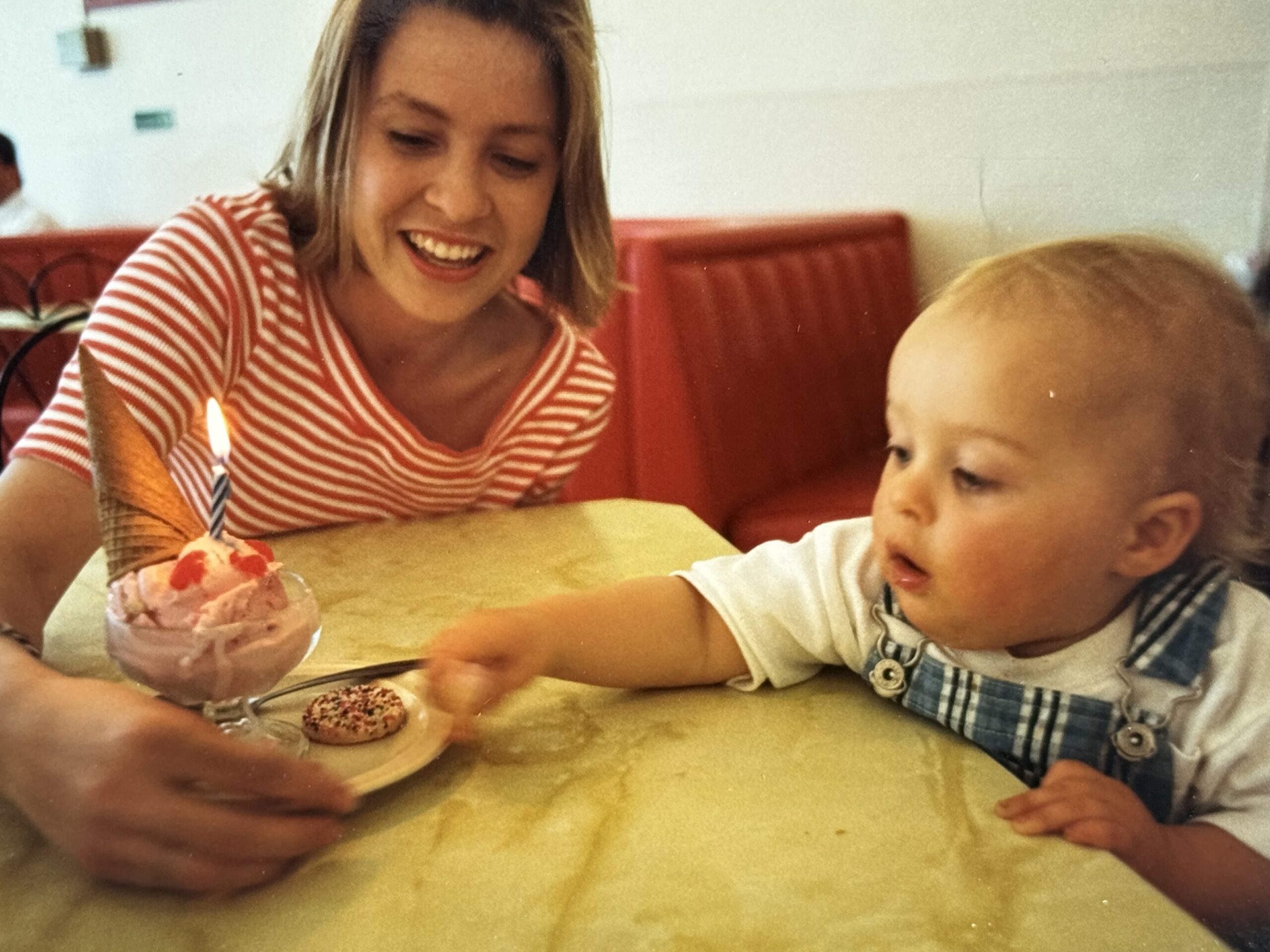
Recently, I came across a portal, a time capsule, some evidence for my notion that it was easier to trust my intuition as a new mother in 1992, back when books and magazines and guests on The Oprah Winfrey Show only had so much influence. Up until this point, the notion itself was based on intuition—I only had anecdotal evidence for my take. Then I reopened my copy of sociologist Sharon Hays’ The Cultural Contradictions of Motherhood, that seminal 1996 text that noted a shift in ’90s mothering, and coined the term intensive motherhood. In one chapter I found Hays discussing her interviews mothers of that time—mothers of my time—and noting that while expert-guided parenthood was on the rise—another book stated that there were five times as many parenting books in 1997 as there’d been in 1975—we ’90s moms mostly used those books as reference, consulting them when needed, but we didn’t entirely trust them. Second to books, she says, we went to our mothers for encouragement—though in true Gen X style, we rejected advice not asked for.
“In short,” she writes, “they take both what they read and what they hear ‘with a grain of salt.'”
But it’s another insight from Hays that really hit it home: ‘90s moms chose books that reaffirmed what we already believed and intuited. “They don’t take the advice they receive that seriously but are merely seeking confirmation of their own methods.” You see the implication, right? We had beliefs and intuitions. No internet mucking up our minds, we had space in our days to let our intuition speak.
I know from talking to parents at my reading series that it’s different now, that the omnipresence of advice and “expertise,” makes it much harder to tune out. (Dr. Emily Edlynn just wrote about this.)
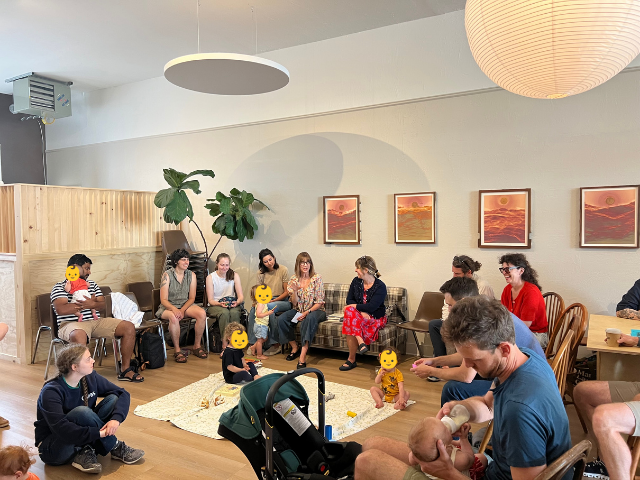
We talked about this at our most recent gathering with Dr. Darby Saxbe, clinical psychologist, psychology professor and author of the fascinating book Dad Brain. (And what a fantastic gathering it was! So many dads showed up! Dads feeding infants, toting toddlers, juggling multiple kids, or coming solo, for inspiration and community!) For years Darby has been studying the brains of new fathers. Her book documents how fatherhood changes men’s brains, hormones, and bodies. What’s most interesting to me is that these changes come from the fathers’ interactions with their babies. Experience with kids is what changes men to make them more effective fathers. When I asked about parenthood amid this glut of “expertise,” Darby said, “Looking at ‘expert’ advice on a phone won’t do that.” Repetition and practice is what creates change. “Great parents are made,” she said, “not born.”
And I suppose that’s what I’ve come to believe about intuition too. I’m less interested in the biological underpinnings of intuition, and more interested in how our beliefs and confidence as parents can grow, underground, both fast and slow, borne of our interactions with and observations of our kids. If we can tune out extra noise and let our inklings flourish, the endless choices about childhood will be a little—or a lot—easier.
As always,
Patricia
P.S. I’ve already rambled on long enough, but do check out this episode of the new podcast Birth of a Parent to hear how the minds of babies and parents synchronize in small moments of connection. The whole episode absolutely synchronizes with what I’ve written here—and it lands on the importance of play, which you know I love.
P.P.S. If you’re local to the bay, please consider joining our next event in the Storytime for Caregivers series. On Tuesday August 18, Vanessa Hua will join us to discuss her latest novel Coyoteland. A story of family, community, and the collision of real estate development, fire season, foraging, and a rogue coyote—all set locally, in the east bay hills! Bring a baby, a friend, or come on your own!
1. Yes, I homeschooled with my kids. I was a former public-school teacher who saw homeschooling as a way to save on childcare costs, as a grand experiment in progressive education. My kids turned everything I thought I believed about learning on its head, taught me to value interest-led learning and independence. Yes, we had a vibrant community of friends. Yes, all three chose to attend high school. Yes, I believe that homeschooling expanded my kids’ worlds, rather than limiting them. No, I don’t believe that everyone should homeschool. I want public schools to thrive and wish we could bring more homeschool-style interest-led, individualized learning to the public school classroom.
Cross-posted on Substack.