I gave my Nurturing Young Writers workshop to a small group of homeschoolers the other night. Part of the workshop is a quick exercise, which, judging from the reaction it gets, is effective. The following is a snippet from a book chapter I’m working on, explaining what I ask them to do.
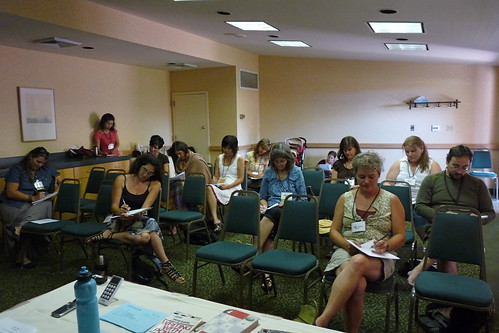
Participants in my workshop this summer. I must have taken this photo during the second part of the exercise: I only see one lefty.
When I give workshops to homeschooling parents on nurturing their children’s writing, I often start with a writing exercise. I allay their anxieties right off, explaining that they won’t have to share what they write. And I entice them with an assignment both simple and intriguing: write a description of the room we’re sitting in. “Focus on whatever interests you: the people, the room itself, the chairs, the walls. Use your senses and describe what you hear out the open door, what you smell, the feel of the desk beneath your fingers. Take two minutes, and try not to think too much. Just write.”
And then, as they’re cracking their notebooks and picking up pens, I lay it on them: “Oh, but wait! I have a few constraints for you.”
Whereupon I ask them to place their pens or pencils in their non-dominant hands: lefties will write with their right hands, righties with their left. Also, they should write from right to left, rather than the traditional (in English anyway) left-to-right. Each letter should be a mirror image of its usual form. “And when it comes to vowels, I want you to think in alphabetical order: A-E-I-O-U. Each time you need to write a vowel, rather than writing the vowel you intend to, write the next vowel in A-E-I-O-U order: a‘s become e‘s; e‘s become i’s, and when you need a u, write an a instead.”
They look at me baffled, as if I’ve just asked them to remove their tongues, and I pick up my timer and smile. “Ready?”
It’s a fun two minutes. As they work, some giggle at their own ineptitude. Some groan. Others gasp in dismay.
When the timer goes off, they exhale with drama. They drop heads to desks. I ask how much they got down. Most finish a single sentence; a few manage part of a second. Without discussing much more, I reset the timer and ask them to repeat the assignment once more, but this time they can write as they usually do. “A description of the room. Focus on what you want to. Don’t think too much. Two minutes. Go!”
“How much did you get down this time?” I ask the participants, as the timer goes off a second time.
Most say they wrote at least five sentences. “I could have written more,” one woman points out, “but the sentences were more complex this time.”
“When you wrote the first time, what were you thinking as you wrote? Did you have a sense of where you were going, what you would write next?”
“I just focused on one word at a time,” says another woman. “I couldn’t keep track of what I was trying to say.” She shakes her head back and forth slowly, like a sad farmer appraising the damage after a storm. “Now I know how my five-year-old feels when she writes.”
Exactly. I want parents to remember how formidable it is to be a beginning writer.
Confusing as interchanging vowels might seem, it’s not nearly as difficult as spelling words is for a beginning writer, although the vowel-shuffling is my attempt to replicate that struggle somewhat.
Regardless, the task is challenging. I encourage you, especially if you have a young child at home, to take five minutes to try it yourself. Just reading about it won’t give you the tangible experience of doing it. Try both parts of the exercise–first describing whatever room you’re in with the above-mentioned constraints, and then without–to experience the difference between the two. The difference between being a fledgling writer and a fluent one.
Then maybe you’ll have a better sense of why I think taking dictation from young writers is so important.
Patricia-
Love this. I look at this through the lens of my own experience, which would be, for Benen, being not yet even an early writer, but an early listener and talker. It is reminders like this that give me pause to look at him with empathy and remain in awe for the bigness of the experience. What a beautiful exercise in what it feels like to be new and small!
I wish I was better at stepping into my kids’ shoes more often. With writing it’s easier for me, because I’m a perpetual student of writing myself. I can relate to how hard it can be.
Brilliant! Seriously. We are loving dictation around here, because it is so FREEING. And honestly it’s reassuring for me, as well–because I can see and hear the complex thinking and sentence structure and word choice that is there once she is freed from the constraints of the mechanics of getting the words down.
Yes, yes, yes! I am so happy you’re recognizing the fantastic potential in taking dictation. All those complex thoughts and sentences and words generally get put on hold until kids develop writing fluency–which can take years. I’m glad you see all that your daughter is getting from it!
Patricia, the only trick is convincing HER that she’s still writing even if I’m putting the words down. I made some reference the other day to the story she’s writing, and she said, “But, Mom, I’m not doing the writing, you are.” I tried to make the distinction between the physical act of writing and composition, but I’m not so sure she bought it….
Which shows how much kids–and many adults as well–tend to think of “writing” as the physical task of writing. But if you were to ask professional writers what skills are important in their work, I’m sure that the mechanics of writing wouldn’t even make their top ten lists: the real work of writing is in the thinking that goes into it.
I tell my kids all the time that the most important part of their writing is their thinking. Especially when they transfer over to doing some of their writing on their own–I don’t want them to get hung up on spelling or penmanship. They can save that for the occasional final draft that they want to share with others. (Just last night, my oldest was working on a college application essay. I had to keep reminding him of Anne Lamott’s excellent writing advice: shitty first drafts. The point is to just throw a bunch of stuff on to the page without worrying about the shape of it–much less the spelling or the punctuation. What’s most important is getting your ideas out of your head, in some form or another. Then you’ll have something to work with.)
And if M. wants to work on her physical writing, encourage her to do so on simple tasks that don’t require a lot of thought: labeling drawings, making lists, etc.
Just keep telling her that what’s most important in writing are her good ideas. And it sounds like she has a lot of them. Eventually, I’m sure she’ll buy it. And it will be good advice for her to remember as she matures as a writer.
Patricia, thanks as always for your thoughtful comments. M. is taking a writing workshop right now, and the teacher made the very helpful suggestion to “write messy”–i.e. don’t worry about careful letter formation. This has been a huge revelation! (And also helpful, I think, to have it come from someone who is not her mother.)
Another thing this reminded me of…at one point, I realized that dictation was just as helpful in MATH as in writing. In the same way that the mechanics of writing can’t keep up with her language, the physical act of writing numbers was so much slower than the rate at which her mind could work the problems. When I sat down and acted as her scribe, she whizzed through equation after equation. And, interestingly–unlike writing–she in no way thought that I was doing the math for her. Maybe that’s an analogy that would make sense?
I’m glad she has a workshop teacher who is giving her such good advice! And of course, she’s telling her to “write messy” because she wants the kids’ focus to be on their ideas. Maybe pointing that out to M. will help her transition her thoughts on what writing is. (I don’t know if they only share work they’ve written in the class–in my workshops I’ve always encouraged kids to have their parents transcribe the work they bring, if that helps them.)
And I’m so glad you were able to make that leap into math too! Our kids are so smart, and the act of physical writing can sure slow them down, can’t it? Kudos to you for recognizing that. And that does sound like a good analogy to share with M. I like to tell parents not to worry about writing for their kids–I promise that they’ll grow out of it. By the time they have Facebook accounts, they won’t want us writing for them. Really!
Sorry to keep rambling…I love talking writing!
Not to hijack your post, Patricia–but I just had to share that M. has spent about the last two hours madly writing in her journal working on her “book.” She had been writing while hanging out with me, frequently asking me how to spell words. I suggested that she could treat this as a first draft rather than a final product–and in the same way that she wasn’t worrying too much about writing perfect letters, she didn’t need to worry about perfect spelling. Well, hallelujah, it worked! She said, OH, I can just spell it however and then we can go over it together and fix the spelling if we need to. Then she put her head down and started writing and hasn’t really looked up since. I need to get her to stop so I can feed her! Anyway, I thought you would appreciate this story.
Oh please do hijack my posts–the comments are where the fun is!
I’m so excited for M! Some kids aren’t willing to go along with invented spelling–they don’t like knowing that they’re doing something “wrong”. But when they’re willing to take that in stride, it really can free them!
I think that writing can shackle kids when they feel like it’s something they *have* to do. But when it’s just a fun option for them, they often latch onto it, as M. has, which is fabulous. (My kids often took on similar projects when they got tired of waiting for me to take dictation!) Even when they’re willing to write themselves, I still like the idea of offering dictation, because I think they’re able to “write” at a more sophisticated level when they don’t have to do the physical writing. And it’s good for them to experience that. But if they can also develop fluency through their own self-guided projects? Fantastic!
I read this post aloud in the car and the kids got a real kick out of it–how the adults act like kids sighing loudly and groaning. I tried it this morning and I got down 16 words. I was just the kind of geeky ambidextrosity-desiring kid who trains herself to write backwards with her non-dominant hand, so it should not have been that hard to do this exercise. But I could still see how having to think even a little about all those things threw a wrench in my thinking. Wish I could have been at the seminar!
Oh, that makes me laugh that you spent time as a kid writing backwards with your non-dominant hand. 16 words is pretty impressive. And that’s exactly what I want parents to get from the exercise: that being a new writer is hard, and yes, struggling with it throws a wrench in your thinking!
I’m going to try this and I’m going to give my 5yo a big hug. Not necessarily in that order. I am so excited for your book!
Promise you’ll try it. You won’t believe how hard it is.
Great advice for parents and teachers! Richard Lavoie has some great resources for getting into kids’ shoes and understanding what it’s like to learn differently. This kind of reminded me of some of the strategies he uses.
Thanks for coming by and leaving a comment, Kelly! I hadn’t heard of Richard Lavoie. I’d be interested in checking out his strategies.
What a great way to begin your workshop.
That is a sure way for parents to realize what’s it’s like for kids to write.
I’m all for dictation, but I also think children need to practice the mechanics of writing regularly, in order to get better at it. I encourage invented spelling.
Today we alternated writing fortunes before we make fortune cookies. All we wrote were short simple descriptions. It gave Cecil the chance to write something meaningful that was also brief.
Would you share writing activities that are short and sweet which you’ve found to be successful for beginning writers. I know there are a lot of ideas out there, but I’d like to know which ones you’ve used and enjoyed.
I totally agree with you Kristin, about kids needing to practice the mechanics of writing too. I talked about that during the workshop–but there’s only so much space in a blog post!
I think dictation is a way for kids to develop their writing voices as they’re developing their written fluency. If we leave all the writing to them, then for a few years they’re mostly working on just mechanics, and not able to develop their voices on the page. But if we take dictation from them occasionally, and they do simple writing on their own, by the time they’re fluent writers, they’ll already have developed strong, more sophisticated written voices.
I think it’s helpful for beginning writers to do the physical practice of writing with tasks that don’t require a lot of thought–so they can concentrate on the mechanics without being frustrated that they can’t express themselves. I like to notice the types of writing they’re already doing, and encourage that: signs for games they’re playing, labeling pictures, making lists. (Mr. T just started a notebook of lists, which I’ll encourage him to add to. He wrote a list of things he wanted for his birthday, some sort of Pokemon list…) Simple instructions (with pictures if they like to draw): how to do a science experiment, how to make a recipe–real or invented. Making labels for “museums” of something they’re learning about is something my kids have liked to do. When I take dictation from T, he often does some of the writing: chapter titles, dialogue bubbles to go with his illustrations, etc.
Some young kids like to do “copywork”, which can simply be copying lines from a favorite book. It gives them a chance to copy correct spelling and punctuation, and to practice their penmanship, without worrying about content. I’ve never done this with my kids though, because it seems that they find plenty of opportunities to practice writing, based on what they’re playing and doing.
I’m not sure this is helpful–I have more thoughts on this, but maybe that’s for another blog post! I guess my main thought is that I try to look at the opportunities that arise based on my kids’ interests and motivation, because I don’t want writing to become drudgery. Activities like your fortune one–where parent and child are writing back and forth to each other–sound fun. Fun, to me, is key!
Wow and interesting. Thank you for sharing this, and for making me think about it!
“Wow and interesting” is feedback I like to hear! Thanks, Sarah.
thank you! My non writing 8 year old dictated a story for me this morning. I’m thrilled. I have backed right off the trying to get him to write thing. I think he enjoyed seeing his story come out on paper. His younger brothers both then wanted me to write their stories down too. THANK YOU!
MamaLou, I’m glad he enjoyed dictating his story to you! I have so many more thoughts on this–I’m working on the dictation chapters in my book right now, and my mind is swimming with why it can be a powerful thing to do with young writers. I just hope you can keep up with all your eager young storytellers!
Thanks for taking the time to tell me how it went.
GREAT illustration that applies not to just young students but any student who struggles with spelling or other aspects of the writing process and feels like writing is just impossible. It’s important to have expectations that more closely line up with our children’s current abilities and scaffold gently to help them increase their skills. I want to try this with our homeschool group sometime!
It really is effective–we forget how incredibly complex writing is for a beginning or struggling writer. It’s a fun activity to do with a group of homeschooling parents, for sure. (This post got a ton of traffic yesterday. I’m curious–how did you find it?)
Thanks for saying hello, Merry!
The link was shared on the Sonlight board last night, so maybe that’s at least part of the source?
Ah, that makes sense. Thanks for letting me know!
WOW! My kids HATE to write, well, my daughter more than my son. They are 6 and 8. I do some dictation with them, more with the younger one. I have lots of questions, and please feel free to point me to other articles that you have written if that is more appropriate than answering these questions. Please know that I am seeking, not slamming. I want to have my children love writing. Both are very creative in their own way, and I would love to have them enjoy writing in a way I never did. So here are my questions: I know that acting as their scribe allows them the freedom of getting their thoughts down, but when do the transfer occur for them to begin to write, physically write, on their own? How do they improve their automaticity of the physical act of writing, as well as the grammar and spelling fluency, if they are not writing on their own? How do you work on revising and editing with dictation? Thank you for your guidance.
Thanks so much for stopping by, Wendy! These are all good questions, and yes, I’ve written posts about several of them. Did you see my series on taking dictation from kids, The Dictation Project? http://patriciazaballos.com/the-dictation-project/ Some of those posts discuss the questions you’ve raised. Then there are many other posts on writing, here: http://patriciazaballos.com/writing-with-kids/ In particular, there’s a post on spelling here: http://patriciazaballos.com/2013/04/02/become-a-writing-mentor-to-your-child-part-4-that-niggling-thing-called-spelling/ and grammar here: http://patriciazaballos.com/2013/04/23/become-a-writing-mentor-to-your-child-part-5-grammar-by-ear/ And you might like this overview of my thoughts on writing. This post has gone a bit viral over the years: http://patriciazaballos.com/2012/05/31/how-do-kids-really-learn-to-write-2-0/
I took dictation from my youngest for years, and I also encouraged the parents of kids in my writer’s workshop to take dictation from their kids as well. Those kids are 13, 14, 15 years old now, and they all write fluently on their own, no problem, and have for several years. I think you’ll grasp the how if you read some of those posts I mention above. I think the key is to lose the typical school timetable for these things, and to have patience that their skills will develop naturally if they like to write. Your kids are young–they have lots of time to learn. Try to find ways to help them enjoy writing. My best suggestions for doing that are taking dictation from them (from the 8-year-old too!) and finding audiences for their writing. (You can find ideas for both in the posts linked above.)
Good luck! And feel free to send along any other questions you might have!